School English Notes
深圳小学英语教材:上海教育出版社。具体教材可参考:这里
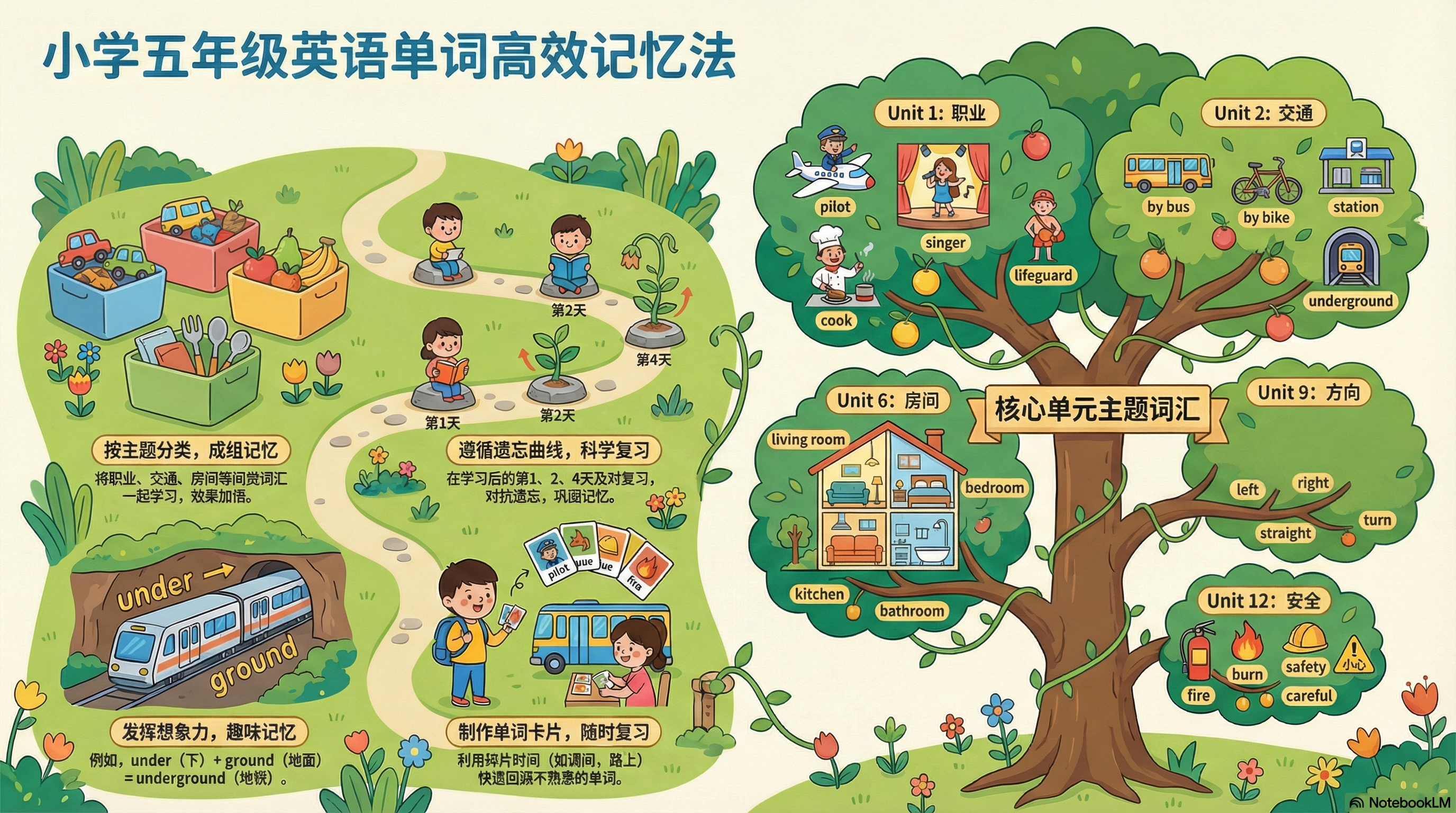
单词记忆方法
1. 分类记忆法(按主题分组)
将单词按主题分类,同类单词一起记忆效果更好:
- Unit 1: 职业类(pilot, cook, singer, lifeguard)
- Unit 2: 交通类(by bus, by bike, station, underground)
- Unit 3: 序数词(first, second, third…)
- Unit 4: 频率副词(usually, often, sometimes, always, never)
- Unit 5: 日常交流类(clever, same, class, ask, answer, each other)
- Unit 6: 房间类(living room, bedroom, kitchen, bathroom)
- Unit 7: 度假类(beach, sunshine, shell, sea)
- Unit 8: 远足探险类(outing, map, hill, find, diamond, lake)
- Unit 9: 方向类(left, right, straight, turn)
- Unit 10: 副词类(gently, softly, strongly, slowly, quickly)
- Unit 11: 生活自然类(tap, use, vegetable, farmer, mountain, tree)
- Unit 12: 安全类(fire, burn, safety, careful)
2. 艾宾浩斯遗忘曲线复习法
根据遗忘曲线规律,科学安排复习时间:
- 第1天:学习 Unit 1-4
- 第2天:复习 Unit 1-4,学习 Unit 5-8
- 第3天:复习 Unit 1-8,学习 Unit 9-12
- 第4天:全面复习,重点攻克薄弱单元
3. 联想记忆法
通过联想帮助记忆:
- 词根联想:
underground= under(下)+ ground(地面)= 地铁 - 音形联想:
journey听起来像”就你”,想象”旅程就你一个人” - 场景联想:
living room(客厅)→ 生活的地方
4. 卡片记忆法
- 制作单词卡片:正面英文,背面中文
- 快速过一遍,把会的放一边,不会的反复看
- 利用碎片时间(上学路上、课间)复习
5. 口诀记忆法
- 序数词规律:
first, second, third特殊记,fourth开始加-th - 频率副词排序:
always > usually > often > sometimes > never
6. 重点攻克难点单词
- 长单词:
favourite,interesting,thirteenth,twenty-first - 易混淆:
bringvsthing,quiet(/ˈkwaɪət/) vsquite(/kwaɪt/) - 短语:
(be) good at,have a good time,each other
7. 实战练习建议
- 每天默写1-2个单元
- 用单词造句,加深理解
- 找同学互相听写,互相纠正
8. 考前冲刺(最后1-2天)
- 快速浏览所有单词,标记不熟悉的
- 重点复习标记的单词
- 做模拟测试,查漏补缺
英语五年级上册单词
Unit 1
Title: My future Category: 职业类
- future /ˈfjuːtʃə/ 将来;未来
- 例句:I want to be a teacher in the future. (我将来想成为一名老师。)
- want /wɒnt/ 想要
- 例句:I want an apple. (我想要一个苹果。)
- pilot /ˈpaɪlət/ 飞行员
- 例句:My uncle is a pilot. (我叔叔是一名飞行员。)
- 记忆:pilot 开飞机,pilot 很厉害!
- teach /tiːtʃ/ 教(课)
- 例句:My teacher teaches English. (我的老师教英语。)
- cook /kʊk/ 厨师;烹饪
- 例句:My mother is a good cook. (我妈妈是个好厨师。)
- taxi driver /ˈtæksi ˈdraɪvə/ 出租车司机
- 例句:The taxi driver is very friendly. (出租车司机很友好。)
- 记忆:taxi(出租车)+ driver(司机)= taxi driver
- job /dʒɒb/ 工作;职业
- 例句:What’s your job? (你的工作是什么?)
- singer /ˈsɪŋə/ 歌手
- 例句:She wants to be a singer. (她想成为一名歌手。)
- 记忆:sing(唱歌)+ er(人)= singer(歌手)
- fall /fɔːl/ 掉落;落下
- 例句:The apple falls from the tree. (苹果从树上掉下来。)
- lifeguard /ˈlaɪfɡɑːd/ 救生员
- 例句:The lifeguard helps people at the beach. (救生员在海滩帮助人们。)
- 记忆:life(生命)+ guard(守卫)= lifeguard(救生员)
- save /seɪv/ 救;救助;节约
- 例句:The lifeguard saves people. (救生员救人。)
- become /bɪˈkʌm/ 变成;变得
- 例句:I want to become a doctor. (我想成为一名医生。)
- (be) good at /biː ɡʊd æt/ 擅长
- 例句:I am good at English. (我擅长英语。)
Unit 2
Title: Going to school Category: 交通类
- by /baɪ/ (表示方式);靠近
- 例句:I go to school by bus. (我乘公共汽车去学校。)
- walk /wɔːk/ 走;步行
- 例句:I walk to school every day. (我每天步行去学校。)
- Ms /mɪz/ 女士
- 例句:Ms Wang is my teacher. (王女士是我的老师。)
- journey /ˈdʒɜːni/ 旅程;旅行
- 例句:It’s a long journey. (这是一次长途旅行。)
- primary school /ˈpraɪməri skuːl/ 小学
- 例句:I study at a primary school. (我在小学学习。)
- 记忆:primary(初级的)+ school(学校)= primary school(小学)
- underground /ˈʌndəɡraʊnd/ 地铁
- 例句:I take the underground to school. (我乘地铁去学校。)
- 记忆:under(下)+ ground(地面)= underground(地铁)
- station /ˈsteɪʃən/ 车站
- 例句:The train station is big. (火车站很大。)
- take /teɪk/ 乘坐(交通工具);带领
- 例句:I take the bus to school. (我乘公共汽车去学校。)
- after /ˈɑːftə/ 在……后
- 例句:I do homework after school. (放学后我做作业。)
- hour /ˈaʊə/ 小时
- 例句:I sleep for eight hours. (我睡八小时。)
- bus stop /bʌs stɒp/ 公共汽车站
- 例句:I wait at the bus stop. (我在公共汽车站等车。)
- 记忆:bus(公共汽车)+ stop(站)= bus stop
- by bus /baɪ bʌs/ 乘公共汽车
- 例句:I go home by bus. (我乘公共汽车回家。)
- far from /fɑː frɒm/ 离……远
- 例句:My school is far from my home. (我的学校离我家很远。)
- on foot /ɒn fʊt/ 步行
- 例句:I go to the park on foot. (我步行去公园。)
- by bike /baɪ baɪk/ 骑自行车
- 例句:I go to school by bike. (我骑自行车去学校。)
- by car /baɪ kɑː/ 乘小汽车
- 例句:My father goes to work by car. (我爸爸开车去上班。)
- get off /ɡet ɒf/ 下车
- 例句:I get off the bus at the school. (我在学校下车。)
Unit 3
Title: My birthday Category: 序数词
- party /ˈpɑːti/ 聚会
- 例句:I go to a birthday party. (我去参加生日聚会。)
- when /wen/ 什么时候
- 例句:When do you go to school? (你什么时候去学校?)
- begin /bɪˈɡɪn/ 开始
- 例句:The class begins at eight. (课在八点开始。)
- bring /brɪŋ/ 带来
- 例句:Please bring your book. (请带上你的书。)
- 记忆:bring(带来)和 thing(东西)容易混淆,bring 是动作
- thing /θɪŋ/ 东西;事物
- 例句:This is a nice thing. (这是一个好东西。)
- 记忆:thing(东西)和 bring(带来)容易混淆,thing 是名词
- favourite /ˈfeɪvərɪt/ 最喜欢的
- 例句:Apple is my favourite fruit. (苹果是我最喜欢的水果。)
- interesting /ˈɪntrəstɪŋ/ 有趣的
- 例句:This book is very interesting. (这本书很有趣。)
- hat /hæt/ 帽子
- 例句:I wear a red hat. (我戴一顶红帽子。)
- have fun /hæv fʌn/ 尽情玩
- 例句:We have fun at the party. (我们在聚会上玩得很开心。)
- first /fɜːst/ 第一
- 例句:I am the first in the race. (我在比赛中得了第一。)
- second /ˈsekənd/ 第二
- 例句:He is the second student. (他是第二个学生。)
- third /θɜːd/ 第三
- 例句:Today is the third day. (今天是第三天。)
- fourth /fɔːθ/ 第四
- 例句:Today is the fourth day. (今天是第四天。)
- 记忆:four(四)+ th = fourth(第四)
- fifth /fɪfθ/ 第五
- 例句:This is the fifth book. (这是第五本书。)
- 记忆:five(五)→ fifth(第五),注意 ve 变 f 再加 th
- sixth /sɪksθ/ 第六
- 例句:I am in the sixth grade. (我在六年级。)
- 记忆:six(六)+ th = sixth(第六)
- seventh /ˈsevənθ/ 第七
- 例句:This is the seventh month. (这是第七个月。)
- 记忆:seven(七)+ th = seventh(第七)
- eighth /eɪtθ/ 第八
- 例句:Today is the eighth day. (今天是第八天。)
- 记忆:eight(八)+ th = eighth(第八),注意只有一个 t
- ninth /naɪnθ/ 第九
- 例句:This is the ninth lesson. (这是第九课。)
- 记忆:nine(九)→ ninth(第九),去掉 e 加 th
- tenth /tenθ/ 第十
- 例句:This is the tenth question. (这是第十个问题。)
- 记忆:ten(十)+ th = tenth(第十)
- eleventh /ɪˈlevənθ/ 第十一
- 例句:Today is the eleventh day. (今天是第十一天。)
- 记忆:eleven(十一)+ th = eleventh(第十一)
- twelfth /twelfθ/ 第十二
- 例句:This is the twelfth month. (这是第十二个月。)
- 记忆:twelve(十二)→ twelfth(第十二),注意 ve 变 f 再加 th
- thirteenth /ˌθɜːˈtiːnθ/ 第十三
- 例句:Today is the thirteenth day. (今天是第十三天。)
- 记忆:thirteen(十三)+ th = thirteenth(第十三)
- fourteenth /ˌfɔːˈtiːnθ/ 第十四
- 例句:This is the fourteenth lesson. (这是第十四课。)
- 记忆:fourteen(十四)+ th = fourteenth(第十四)
- fifteenth /ˌfɪfˈtiːnθ/ 第十五
- 例句:Today is the fifteenth day. (今天是第十五天。)
- 记忆:fifteen(十五)+ th = fifteenth(第十五)
- sixteenth /ˌsɪkˈstiːnθ/ 第十六
- 例句:This is the sixteenth question. (这是第十六个问题。)
- 记忆:sixteen(十六)+ th = sixteenth(第十六)
- seventeenth /ˌsevənˈtiːnθ/ 第十七
- 例句:Today is the seventeenth day. (今天是第十七天。)
- 记忆:seventeen(十七)+ th = seventeenth(第十七)
- eighteenth /ˌeɪˈtiːnθ/ 第十八
- 例句:This is the eighteenth lesson. (这是第十八课。)
- 记忆:eighteen(十八)+ th = eighteenth(第十八)
- nineteenth /ˌnaɪnˈtiːnθ/ 第十九
- 例句:Today is the nineteenth day. (今天是第十九天。)
- 记忆:nineteen(十九)→ nineteenth(第十九),去掉 e 加 th
- twentieth /ˈtwentiəθ/ 第二十
- 例句:This is the twentieth question. (这是第二十个问题。)
- 记忆:twenty(二十)→ twentieth(第二十),y 变 ie 加 th
- twenty-first /ˌtwenti ˈfɜːst/ 第二十一
- 例句:Today is the twenty-first day. (今天是第二十一天。)
- 记忆:twenty(二十)+ first(第一)= twenty-first
- twenty-second /ˌtwenti ˈsekənd/ 第二十二
- 例句:This is the twenty-second lesson. (这是第二十二课。)
- 记忆:twenty(二十)+ second(第二)= twenty-second
- twenty-third /ˌtwenti ˈθɜːd/ 第二十三
- 例句:Today is the twenty-third day. (今天是第二十三天。)
- 记忆:twenty(二十)+ third(第三)= twenty-third
- twenty-fourth /ˌtwenti ˈfɔːθ/ 第二十四
- 例句:This is the twenty-fourth question. (这是第二十四个问题。)
- 记忆:twenty(二十)+ fourth(第四)= twenty-fourth
- twenty-fifth /ˌtwenti ˈfɪfθ/ 第二十五
- 例句:Today is the twenty-fifth day. (今天是第二十五天。)
- 记忆:twenty(二十)+ fifth(第五)= twenty-fifth
- twenty-sixth /ˌtwenti ˈsɪksθ/ 第二十六
- 例句:This is the twenty-sixth lesson. (这是第二十六课。)
- 记忆:twenty(二十)+ sixth(第六)= twenty-sixth
- twenty-seventh /ˌtwenti ˈsevənθ/ 第二十七
- 例句:Today is the twenty-seventh day. (今天是第二十七天。)
- 记忆:twenty(二十)+ seventh(第七)= twenty-seventh
- twenty-eighth /ˌtwenti ˈeɪtθ/ 第二十八
- 例句:This is the twenty-eighth question. (这是第二十八个问题。)
- 记忆:twenty(二十)+ eighth(第八)= twenty-eighth
- twenty-ninth /ˌtwenti ˈnaɪnθ/ 第二十九
- 例句:Today is the twenty-ninth day. (今天是第二十九天。)
- 记忆:twenty(二十)+ ninth(第九)= twenty-ninth
- thirtieth /ˈθɜːtiəθ/ 第三十
- 例句:This is the thirtieth question. (这是第三十个问题。)
- 记忆:thirty(三十)→ thirtieth(第三十),y 变 ie 加 th
- thirty-first /ˌθɜːti ˈfɜːst/ 第三十一
- 例句:Today is the thirty-first day. (今天是第三十一天。)
- 记忆:thirty(三十)+ first(第一)= thirty-first
Unit 4
Title: Grandparents Category: 频率副词
- usually /ˈjuːʒuəli/ 通常
- 例句:I usually go to school at seven. (我通常七点去学校。)
- often /ˈɒfən/ 经常
- 例句:I often read books. (我经常读书。)
- visit /ˈvɪzɪt/ 看望;拜访;参观
- 例句:I visit my grandparents. (我看望我的祖父母。)
- sometimes /ˈsʌmtaɪmz/ 有时
- 例句:Sometimes I play football. (有时我踢足球。)
- always /ˈɔːlweɪz/ 总是;一直
- 例句:I always do my homework. (我总是做作业。)
- never /ˈnevə/ 从不
- 例句:I never go to bed late. (我从不晚睡。)
- play sport /pleɪ spɔːt/ 做运动
- 例句:I play sport every day. (我每天做运动。)
- go shopping /ɡəʊ ˈʃɒpɪŋ/ 去购物
- 例句:My mother goes shopping on Sunday. (我妈妈星期天去购物。)
Unit 5
Title: Friends Category: 日常交流类
- clever /ˈklevə/ 聪明的
- 例句:Tom is a clever boy. (汤姆是个聪明的男孩。)
- same /seɪm/ 相同的
- 例句:We are in the same class. (我们在同一个班级。)
- class /klɑːs/ 班;班级
- 例句:I am in Class One. (我在一班。)
- both /bəʊθ/ (两个)都
- 例句:Both of us like English. (我们两个都喜欢英语。)
- cross /krɒs/ 穿越;越过
- 例句:Don’t cross the road here. (不要在这里过马路。)
- carry /ˈkæri/ 背;提;拿
- 例句:I carry a heavy bag. (我背着一个重包。)
- heavy /ˈhevi/ 重的;沉的
- 例句:This box is very heavy. (这个箱子很重。)
- different /ˈdɪfərənt/ 不同的
- 例句:We are different. (我们是不同的。)
- bored /bɔːd/ 无聊的
- 例句:I feel bored. (我感到无聊。)
- word /wɜːd/ 单词
- 例句:This is a new word. (这是一个新单词。)
- easy /ˈiːzi/ 容易的
- 例句:This question is easy. (这个问题很容易。)
- say /seɪ/ 说
- 例句:What do you say? (你说什么?)
- then /ðen/ 然后;那么
- 例句:First I read, then I write. (我先读,然后写。)
- ask /ɑːsk/ 问
- 例句:I ask the teacher a question. (我问老师一个问题。)
- answer /ˈɑːnsə/ 回答
- 例句:Please answer my question. (请回答我的问题。)
- soon /suːn/ 很快;不久
- 例句:I will come back soon. (我很快回来。)
- each other /iːtʃ ˈʌðə/ 互相
- 例句:We help each other. (我们互相帮助。)
- make phone calls /meɪk fəʊn kɔːlz/ 打电话
- 例句:I make phone calls to my friends. (我给朋友打电话。)
Unit 6
Title: Family life Category: 房间类
- life /laɪf/ 生活
- 例句:Life is beautiful. (生活是美好的。)
- living room /ˈlɪvɪŋ ruːm/ 客厅
- 例句:We watch TV in the living room. (我们在客厅看电视。)
- 记忆:living(生活)+ room(房间)= living room(客厅)
- bedroom /ˈbedruːm/ 卧室
- 例句:I sleep in my bedroom. (我在卧室睡觉。)
- 记忆:bed(床)+ room(房间)= bedroom(卧室)
- model plane /ˈmɒdəl pleɪn/ 飞机模型
- 例句:I have a model plane. (我有一个飞机模型。)
- kitchen /ˈkɪtʃɪn/ 厨房
- 例句:My mother cooks in the kitchen. (我妈妈在厨房做饭。)
- bathroom /ˈbɑːθruːm/ 浴室;卫生间
- 例句:I brush my teeth in the bathroom. (我在浴室刷牙。)
- 记忆:bath(洗澡)+ room(房间)= bathroom(浴室)
- their /ðeə/ 他们的;她们的;它们的
- 例句:This is their book. (这是他们的书。)
- light /laɪt/ 灯;光
- 例句:Turn on the light, please. (请开灯。)
- watch /wɒtʃ/ 观看;观察
- 例句:I watch TV in the evening. (我晚上看电视。)
- TV /ˌtiː ˈviː/ 电视;电视机
- 例句:I like watching TV. (我喜欢看电视。)
- before /bɪˈfɔː/ 在……以前
- 例句:I do homework before dinner. (我在晚饭前做作业。)
- bedtime /ˈbedtaɪm/ 就寝时间
- 例句:My bedtime is nine o’clock. (我的就寝时间是九点。)
- 记忆:bed(床)+ time(时间)= bedtime(就寝时间)
- do … homework /duː ˈhəʊmwɜːk/ 做家庭作业
- 例句:I do my homework every day. (我每天做家庭作业。)
- turn off /tɜːn ɒf/ 关掉
- 例句:Turn off the light, please. (请关灯。)
- watch TV /wɒtʃ ˌtiː ˈviː/ 看电视
- 例句:I watch TV after dinner. (我晚饭后看电视。)
- tell a story /tel ə ˈstɔːri/ 讲故事
- 例句:My mother tells me a story. (我妈妈给我讲故事。)
Unit 7
Title: At the beach Category: 度假类
- beach /biːtʃ/ 海滩
- 例句:We play on the beach. (我们在海滩上玩。)
- enjoy /ɪnˈdʒɔɪ/ 享受…的乐趣
- 例句:I enjoy reading books. (我喜欢读书。)
- sunshine /ˈsʌnʃaɪn/ 阳光
- 例句:We enjoy the sunshine on the beach. (我们在海滩享受阳光。)
- 记忆:sun(太阳)+ shine(照耀)= sunshine(阳光)
- collect /kəˈlekt/ 收集
- 例句:I collect shells. (我收集贝壳。)
- shell /ʃel/ 贝壳
- 例句:I find a beautiful shell. (我找到一个漂亮的贝壳。)
- sea /siː/ 海
- 例句:The sea is blue. (大海是蓝色的。)
- letter /ˈletə/ 信
- 例句:I write a letter to my friend. (我给我的朋友写信。)
- put /pʊt/ 放;安置
- 例句:Put the book on the desk. (把书放在桌子上。)
- know /nəʊ/ 知道
- 例句:I know the answer. (我知道答案。)
- year /jɪə/ 年岁;年
- 例句:I am ten years old. (我十岁了。)
- on holiday /ɒn ˈhɒlədi/ 度假
- 例句:We go to the beach on holiday. (我们度假时去海滩。)
- have a good time /hæv ə ɡʊd taɪm/ 玩得高兴
- 例句:We have a good time at the beach. (我们在海滩玩得很开心。)
Unit 8
Title: An outing Category: 远足探险类
- outing /ˈaʊtɪŋ/ 远足
- 例句:We go on an outing. (我们去远足。)
- map /mæp/ 地图
- 例句:I look at the map. (我看地图。)
- hill /hɪl/ 小山
- 例句:There is a hill over there. (那边有一座小山。)
- find /faɪnd/ 发现;找到
- 例句:I find a key. (我找到一把钥匙。)
- diamond /ˈdaɪəmənd/ 钻石
- 例句:The diamond is very beautiful. (钻石很漂亮。)
- another /əˈnʌðə/ 另一个
- 例句:I want another apple. (我想要另一个苹果。)
- lake /leɪk/ 湖
- 例句:The lake is very big. (这个湖很大。)
- funny /ˈfʌni/ 滑稽的;好笑的
- 例句:This story is very funny. (这个故事很有趣。)
- hole /həʊl/ 洞
- 例句:There is a hole in the wall. (墙上有一个洞。)
- key /kiː/ 钥匙
- 例句:This is the key to the door. (这是门的钥匙。)
- think /θɪŋk/ 想
- 例句:I think it’s good. (我认为这很好。)
- at the top of /æt ðə tɒp ɒv/ 在……顶部
- 例句:The flag is at the top of the hill. (旗子在山顶。)
- get through /ɡet θruː/ 通过
- 例句:We get through the hole. (我们通过这个洞。)
Unit 9
Title: Around the city Category: 方向类
- post office /pəʊst ˈɒfɪs/ 邮局
- 例句:I send a letter at the post office. (我在邮局寄信。)
- 记忆:post(邮政)+ office(办公室)= post office(邮局)
- quite /kwaɪt/ 相当;十分
- 例句:It’s quite good. (这相当好。)
- 记忆:quite(相当)和 quiet(安静的)容易混淆,quite 是副词
- along /əˈlɒŋ/ 沿着;顺着
- 例句:Walk along this road. (沿着这条路走。)
- turn /tɜːn/ 转向;转弯
- 例句:Turn left at the corner. (在拐角处向左转。)
- left /left/ 左边
- 例句:The book is on the left. (书在左边。)
- straight /streɪt/ 笔直地
- 例句:Go straight ahead. (一直往前走。)
- right /raɪt/ 右边;正确的
- 例句:Turn right here. (在这里向右转。)
- between /bɪˈtwiːn/ 在…中间
- 例句:The book is between two pens. (书在两支笔中间。)
- flower shop /ˈflaʊə ʃɒp/ 花店
- 例句:My mother buys flowers at the flower shop. (我妈妈在花店买花。)
- 记忆:flower(花)+ shop(商店)= flower shop(花店)
- hospital /ˈhɒspɪtəl/ 医院
- 例句:My father works in a hospital. (我爸爸在医院工作。)
- toy shop /tɔɪ ʃɒp/ 玩具店
- 例句:I buy toys at the toy shop. (我在玩具店买玩具。)
- 记忆:toy(玩具)+ shop(商店)= toy shop(玩具店)
- road /rəʊd/ 路;马路
- 例句:This road is very long. (这条路很长。)
- get to /ɡet tuː/ 到达
- 例句:How do I get to the school? (我怎么到学校?)
Unit 10
Title: Wind Category: 副词类
- blow /bləʊ/ 刮;吹
- 例句:The wind blows gently. (风轻轻地吹。)
- gently /ˈdʒentli/ 和缓地;温柔地
- 例句:The wind blows gently. (风轻轻地吹。)
- softly /ˈsɒftli/ 轻柔地
- 例句:She speaks softly. (她轻声说话。)
- strongly /ˈstrɒŋli/ 强劲地
- 例句:The wind blows strongly. (风强劲地吹。)
- happily /ˈhæpɪli/ 快乐地
- 例句:We play happily. (我们快乐地玩。)
- windmill /ˈwɪndmɪl/ 风车
- 例句:The windmill turns in the wind. (风车在风中转动。)
- 记忆:wind(风)+ mill(磨坊)= windmill(风车)
- move /muːv/ (使)改变位置;移动
- 例句:Don’t move! (别动!)
- slowly /ˈsləʊli/ 缓慢地
- 例句:The old man walks slowly. (老人慢慢地走。)
- quickly /ˈkwɪkli/ 快地;迅速地
- 例句:I run quickly. (我跑得很快。)
- sound /saʊnd/ 声乐;听起来好像
- 例句:It sounds good. (听起来不错。)
- wind-bell /ˈwɪnd bel/ 风铃
- 例句:The wind-bell makes a nice sound. (风铃发出好听的声音。)
- 记忆:wind(风)+ bell(铃)= wind-bell(风铃)
- cut /kʌt/ 剪;砍;切
- 例句:I cut the paper. (我剪纸。)
- paper /ˈpeɪpə/ 纸;纸张
- 例句:I write on paper. (我在纸上写字。)
- quiet /ˈkwaɪət/ 轻声的;安静的
- 例句:Please be quiet. (请安静。)
- 记忆:quiet(安静的)和 quite(相当)容易混淆,quiet 是形容词
Unit 11
Title: Water Category: 生活自然类
- tap /tæp/ 水龙头
- 例句:Turn on the tap. (打开水龙头。)
- use /juːz/ 使用
- 例句:I use water to wash. (我用水来洗。)
- vegetable /ˈvedʒtəbəl/ 蔬菜
- 例句:I like eating vegetables. (我喜欢吃蔬菜。)
- clothes /kləʊðz/ 衣服;服装
- 例句:I wash my clothes. (我洗衣服。)
- farmer /ˈfɑːmə/ 农民
- 例句:The farmer grows vegetables. (农民种蔬菜。)
- 记忆:farm(农场)+ er(人)= farmer(农民)
- useful /ˈjuːsfəl/ 有用的
- 例句:This book is very useful. (这本书很有用。)
- 记忆:use(使用)+ ful(充满的)= useful(有用的)
- drop /drɒp/ 滴;水珠
- 例句:A drop of water falls. (一滴水落下。)
- up /ʌp/ 向上;在上面
- 例句:Look up! (向上看!)
- shine /ʃaɪn/ 照耀
- 例句:The sun shines. (太阳照耀。)
- over /ˈəʊvə/ 在……上方
- 例句:The bridge is over the river. (桥在河上方。)
- mountain /ˈmaʊntɪn/ 山;山脉
- 例句:The mountain is very high. (这座山很高。)
- tree /triː/ 树
- 例句:There is a big tree. (有一棵大树。)
- ground /ɡraʊnd/ 地面
- 例句:The apple falls to the ground. (苹果掉到地上。)
- inside /ˌɪnˈsaɪd/ 在……里面
- 例句:The cat is inside the box. (猫在盒子里。)
- grow crops /ɡrəʊ krɒps/ 种庄稼
- 例句:Farmers grow crops. (农民种庄稼。)
- put out fires /pʊt aʊt ˈfaɪəz/ 灭火
- 例句:Firefighters put out fires. (消防员灭火。)
Unit 12
Title: Fire Category: 安全类
- fire /ˈfaɪə/ 火;火灾
- 例句:Fire is dangerous. (火是危险的。)
- burn /bɜːn/ 燃烧;烧
- 例句:Don’t let the paper burn. (不要让纸烧起来。)
- hurt /hɜːt/ (使)受伤
- 例句:The fire can hurt you. (火会伤害你。)
- must /mʌst/ 必须
- 例句:You must be careful. (你必须小心。)
- careful /ˈkeəfəl/ 小心的
- 例句:Be careful with fire. (小心火。)
- safety /ˈseɪfti/ 安全
- 例句:Safety is important. (安全很重要。)
- smoke /sməʊk/ 吸烟
- 例句:Don’t smoke here. (不要在这里吸烟。)
- match /mætʃ/ 火柴
- 例句:Don’t play with matches. (不要玩火柴。)
- heat /hiːt/ 热;高温
- 例句:The heat is very strong. (热量很强。)
- hate /heɪt/ 讨厌
- 例句:I hate fire. (我讨厌火。)
- burn down /bɜːn daʊn/ 烧毁
- 例句:The fire can burn down the house. (火会烧毁房子。)
- (be) careful with /biː ˈkeəfəl wɪð/ 当心……
- 例句:Be careful with fire. (小心火。)
- not … at all /nɒt æt ɔːl/ 一点也不
- 例句:I don’t like it at all. (我一点也不喜欢它。)
英语五年级下册单词
Unit 1
Title: Tidy up! Category: 家居/动作类,
- tidy /ˈtaɪdi/ 整理;整洁的
- 例句:Let’s tidy it up. (让我们把它整理好。)
- 记忆:ti + dy,整理好东西,大声说“太(ti)地(dy)道”了。
- mess /mes/ 脏乱,不整洁
- 例句:What a mess! (真是乱七八糟!),
- 记忆:m + ess,乱得像“没事(mess)”找事。
- let /let/ 让
- 例句:Let’s tidy it up. (让我们把它整理好。)
- 记忆:l + et,让(let)我们一起去寻找外星人(ET)。
- sock /sɒk/ 短袜
- 例句:Whose socks are those? (那些是谁的袜子?)
- 记忆:s + ock,蛇(s)钻进了大石头(rock)下的袜子里。
- yours /jɔːz/ 你的,你们的
- 例句:Are they yours, Peter? (彼得,它们是你的吗?)
- 记忆:your + s,名词性物主代词通常在形容词性物主代词后加 s。
- cap /kæp/ 帽子
- 例句:Whose cap is this? (这是谁的帽子?)
- 记忆:c + ap,猫(cat)戴着帽子(cap)。
- mine /maɪn/ 我的
- 例句:It’s mine. (它是我的。)
- 记忆:m + ine,我的(mine)地盘我做主。
- crayon /ˈkreɪən/ 彩色蜡笔
- 例句:The crayons are Joe’s. (这些蜡笔是乔的。)
- 记忆:c + ray(光线)+ on,用彩色蜡笔画出阳光。
- umbrella /ʌmˈbrelə/ 伞
- 例句:The umbrella is Alice’s. (这把伞是爱丽丝的。)
- 记忆:um + brella,俺(um)不(b)热(re)了(lla),因为打了伞。
- nail /neɪl/ 钉子
- 例句:It is full of nails. (它装满了钉子。)
- 记忆:n + ail(生病),小鸟(n)被钉子扎了,生病(ail)了。
- drop /drɒp/ 使落下;掉落
- 例句:Jimmy drops the box. (吉米掉下了盒子。)
- 记忆:d + rop(绳子),掉下的(drop)绳子。
- stick /stɪk/ 粘贴;粘住
- 例句:The nails all stick to it. (钉子全都粘在上面了。)
- 记忆:s + tick(滴答声),钟表滴答滴答粘(stick)在墙上。
- second /ˈsekənd/ 秒
- 例句:In a few seconds, the floor is clean again. (几秒钟后,地板又干净了。)
- 记忆:se + cond,色(se)控(cond)选衣服只用几秒钟。
- hers /hɜːz/ 她的
- 例句:Are these hers? (这些是她的吗?)
- 记忆:her + s,她的(hers)。
- theirs /ðeəz/ 他们的,她们的,它们的
- 例句:They are theirs. (它们是他们的。)
- 记忆:their + s,他们的(theirs)。
- tidy up 把……整理好
- 例句:Let’s tidy it up. (让我们把它整理好。)
- 记忆:tidy(整理)+ up(起来)。
- (be) full of 装满……;充满……
- 例句:It is full of nails. (它装满了钉子。)
- 记忆:full(满的)+ of(……的)。
- a few 几个;一些
- 例句:In a few seconds, the floor is clean again. (几秒钟后,地板又干净了。)
- 记忆:a(一个)+ few(很少),指代几个。
Unit 2
Title: Our new home Category: 房屋/描述类
- why /waɪ/ 为什么
- 例句:Why do you like it? (你为什么喜欢它?)
- 记忆:w + hy,读音像“歪”,歪着头问“为什么”。
- because /bɪˈkɒz/ 因为
- 例句:Because it’s so big. (因为它很大。)
- 记忆:be + cause(原因),这就是原因。
- study /ˈstʌdi/ 书房;学习
- 例句:I like the study. (我喜欢书房。)
- 记忆:stu(学生)+ dy(在大地),学生在书房的学习桌前。
- dining room /ˈdaɪnɪŋ ruːm/ 餐室;餐厅
- 例句:I like the dining room. (我喜欢餐厅。)
- 记忆:din(叮)+ ing + room,在房间里叮叮当当地用晚餐。
- wild goose /waɪld ɡuːs/ 大雁(复数 wild geese)
- 例句:Why do wild geese change homes? (大雁为什么要搬家?)
- 记忆:wild(野外的)+ goose(鹅),野外的鹅就是大雁。
- change /tʃeɪndʒ/ 改变;变化
- 例句:They change homes twice every year. (它们每年搬两次家。)
- 记忆:chan(产)+ ge(生),产生了变化。
- place /pleɪs/ 地方
- 例句:They fly from one place to another. (它们从一个地方飞到另一个地方。)
- 记忆:p + lace(蕾丝),那个地方(place)装饰着蕾丝。
- twice /twaɪs/ 两次
- 例句:They change homes twice every year. (它们每年搬两次家。)
- 记忆:t + wice(像 rice),吃了两次(twice)米饭。
- every /ˈevri/ 每;每个
- 例句:They change homes twice every year. (它们每年搬两次家。)
- 记忆:e + very(非常),每个人(every)都非常努力。
- north /nɔːθ/ 北方;向北
- 例句:In spring, they fly north. (在春天,它们向北飞。)
- 记忆:no + rth,北方(north)的天气经常说 No。
- south /saʊθ/ 南方;向南
- 例句:In autumn, they fly south. (在秋天,它们向南飞。)
- 记忆:s + outh(像 mouth),南方(south)人的嘴巴(mouth)很甜。
- enough /ɪˈnʌf/ 足够的
- 例句:They cannot find enough food in the north. (它们在北方找不到足够的食物。)
- 记忆:e + nough,读音像“一拿夫”,拿了一个又一个,已经拿够了。
- then /ðen/ 然后
- 例句:Then in spring, it is warm in the north. (然后到春天,北方就暖和了。)
- 记忆:the + n,在这(the)之后接着发生。
- all day /ɔːl deɪ/ 一天到晚
- 例句:Because they can play in the garden all day! (因为他们可以在花园里玩一整天!)
- 记忆:all(全部的)+ day(天),全部的时间就是一天到晚。
Unit 3
Title: In the future Category: 未来/生活类
- future /ˈfjuːtʃə/ 将来;未来
- 例句:Kitty wants to know about her future. (吉蒂想了解她的未来。)
- 记忆:fu(福)+ ture,未来的福气在等着你。
- stand /stænd/ 站;站住
- 例句:She stands in front of a magic machine. (她站在一台神奇的机器前。)
- 记忆:s + t + and(和),大家都站着和你在一起。
- machine /məˈʃiːn/ 机器
- 例句:She stands in front of a magic machine. (她站在一台神奇的机器前。)
- 记忆:ma(马)+ chi(吃)+ ne(呢),马在吃机器呢。
- will /wɪl/ 将;将会
- 例句:I will be a teacher. (我将成为一名老师。)
- 记忆:w + ill(生病),病好了,“将”会去上学。
- exercise /ˈeksəsaɪz/ 运动;锻炼;活动
- 例句:I will do exercise every day. (我将每天进行体育锻炼。)
- 记忆:ex + er + cise,在外面(ex)锻炼身体。
- early /ˈɜːli/ 早;提早
- 例句:I do not like to get up early. (我不喜欢早起。)
- 记忆:ear(耳朵)+ ly,耳朵听得早(early)。
- easily /ˈiːzəli/ 容易地
- 例句:I get tired easily. (我容易感到疲倦。)
- 记忆:easy(容易的)+ ly(副词后缀)。
- hard /hɑːd/ 努力地
- 例句:I will study hard. (我将努力学习。)
- 记忆:努力的人像“哈(ha)”出的“热(rd)”气一样充满干劲。
- more /mɔː/ 更多的
- 例句:I will read more English books. (我将阅读更多的英语书籍。)
- 记忆:mo(摸)+ re,还要摸索更多的知识。
- in the future 将来
- 例句:This is me in the future! (这就是未来的我!)
- 记忆:in(在……里)+ the future(将来)。
- in front of 在……前面
- 例句:She stands in front of a magic machine. (她站在一台神奇的机器前。)
- 记忆:in + front(前面)+ of。
- take a photo 拍照
- 例句:Kitty … takes a photo. (吉蒂……拍了一张照片。)
- 记忆:take(拿)+ a photo(照片),拿起相机拍照片。
- wear glasses 戴眼镜
- 例句:I won’t wear glasses. (我将不戴眼镜。)
- 记忆:wear(穿/戴)+ glasses(眼镜,像两块玻璃glass)。
- do exercise 做运动
- 例句:I will do exercise every day. (我将每天做运动。)
- 记忆:do(做)+ exercise(运动)。
- (be) weak in 不擅长
- 例句:I am weak in English. (我不擅长英语。)
- 记忆:weak(虚弱的)+ in(在……方面),在某方面虚弱就是不擅长。
- not … any more 不再
- 例句:I will not be late for school any more. (我将不再上学迟到。)
- 记忆:not(不)+ any more(更多),不会再有更多次了。
Unit 4
Title: Reading is fun Category: 阅读/学习类
- storybook /ˈstɔːribʊk/ 故事书
- 例句:There are many storybooks. (有很多故事书。)
- 记忆:story(故事)+ book(书)。
- buy /baɪ/ 买
- 例句:I’m going to buy one. (我打算买一本。)
- 记忆:谐音“摆”,把买回来的东西摆在桌子上。
- story /ˈstɔːri/ 故事
- 例句:I’m going to read a story every day. (我打算每天读一个故事。)
- 记忆:s + tory(看作 toy 玩具),讲一个关于玩具的故事。
- dictionary /ˈdɪkʃənri/ 字典;词典
- 例句:The Lis are at the bookshop. They’re going to buy dictionaries. (李一家在书店,他们打算买词典。)
- 记忆:dic(说)+ tion + ary,能开口“说”话的工具书。
- magazine /ˌmæɡəˈziːn/ 杂志
- 例句:There are newspapers and magazines on the ground floor. (一楼有报纸和杂志。)
- 记忆:ma(马)+ ga(嘎)+ zine(谐音:新),马在看一份新的杂志。
- newspaper /ˈnjuːzpeɪpə/ 报纸
- 例句:He’s reading a newspaper. (他正在读报纸。)
- 记忆:news(新闻)+ paper(纸),印有新闻的纸。
- week /wiːk/ 周;星期
- 例句:Book Week is coming! (读书周就要到了!)
- 记忆:w + eek(尖叫声),过了这一周就想开心得尖叫。
- student /ˈstjuːdnt/ 学生
- 例句:The students in Class 5A are going to make posters. (5A班的学生们打算制作海报。)
- 记忆:stu(学习)+ dent(牙齿),学生正在努力学习,咬紧牙齿。
- poster /ˈpəʊstə/ 海报
- 例句:They are going to make posters about the best stories for children. (他们打算制作关于最受孩子们欢迎的故事的海报。)
- 记忆:post(邮寄)+ er(者),用来邮寄宣传的者(东西)。
- best /best/ 最好的
- 例句:These are the best stories for children. (这些是给孩子们最好的故事。)
- 记忆:be + st(最强的后缀),成为最强的,就是最好的。
- writer /ˈraɪtə/ 作家
- 例句:They are going to write about the writers and the stories. (他们打算写写作家和这些故事。)
- 记忆:write(写)+ r(的人),写书的人就是作家。
- over there /ˌəʊvə ˈðeə/ 在那边
- 例句:I’m going to look at the picture books over there. (我打算看一看那边的图画书。)
- 记忆:over(翻过)+ there(那里),翻过这里到那边去。
- do a survey 做调查
- 例句:The boys are going to do a survey about children’s favourite books. (男生们打算做一个关于孩子们最喜欢的书的调查。)
- 记忆:do(做)+ a + survey(调查)。
- act … out 表演
- 例句:The girls are going to read a play and then act it out. (女生们打算读一个剧本,然后把它表演出来。)
- 记忆:act(行动)+ out(出来),通过行动表现出来。
Unit 5
Title: At the weekend Category: 周末/计划类
- weekend /ˈwiːkˈend/ 周末
- 例句:What are you going to do this weekend? (这个周末你打算做什么?)
- 记忆:week(周)+ end(末尾),一周的末尾就是周末。
- stay /steɪ/ 待;暂住;逗留
- 例句:I’m going to stay at home. (我打算待在家里。)
- 记忆:s + tay(谐音:太),待在家里实在是太(tay)无聊了。
- film /fɪlm/ 电影
- 例句:I’m going to see a film with my parents. (我打算和父母去看场电影。)
- 记忆:f + ilm,坐在电影院里喝着冰(i)冷(l)的麦(m)片看电影。
- boat /bəʊt/ 小船;舟
- 例句:I’m going to row a boat. (我打算划船。)
- 记忆:b + oat(燕麦),想象一艘装着燕麦的小船。
- plan /plæn/ 安排;计划
- 例句:I don’t have any plans for the weekend. (我周末没有任何计划。)
- 记忆:p + lan(蓝),计划去看看蓝天。
- tomorrow /təˈmɒrəʊ/ 明天
- 例句:I’m going to build one tomorrow. (我明天打算盖一座。)
- 记忆:to(去)+ morrow(早晨),去迎接明天的早晨。
- build /bɪld/ 建筑;建造
- 例句:I’m going to build one tomorrow. (我明天打算盖一座。)
- 记忆:b + uild,不用(u)我的(i)力量(l)打(d)基础,就不能建造大楼。
- next /nekst/ 紧接着;随后;紧接着的
- 例句:The next day is Sunday. (第二天是星期天。)
- 记忆:n + ext,下一个(next)是内(ne)部选(x)拔(t)。
- swing /swɪŋ/ 秋千
- 例句:On the third day, he finds a swing. (第三天,他发现了一个秋千。)
- 记忆:s + wing(翅膀),荡起秋千像长了翅膀(wing)一样。
- cry /kraɪ/ 哭;喊叫
- 例句:The baby starts to cry. (宝宝开始大声哭喊。) (注:此句为补充例句,教材中单词见)
- 记忆:c + ry,哭的声音像“快(c)让(r)开(y)”。
- until /ʌnˈtɪl/ 直到
- 例句:He sleeps until morning. (他一直睡到早晨。) (注:此句为补充例句,教材中单词见)
- 记忆:un + til,读音像“俺抬头”,直到(until)俺抬头才发现天黑了。
- see a film 看电影
- 例句:I’m going to see a film on Saturday afternoon. (我打算在周六下午看电影。)
- 记忆:see(看)+ a film(电影)。
- row a boat 划船
- 例句:I’m going to row a boat and fly a kite. (我打算划船和放风筝。)
- 记忆:row(划)+ a boat(小船)。
Unit 6
Title: Holidays Category: 假期/旅游类
- holiday /ˈhɒlədeɪ/ 假日;假期
- 例句:It’s a wonderful place for a holiday. (这是一个度假的好地方。)
- 记忆:holi(神圣的)+ day(日子),神圣的日子就是假期。
- clear /klɪə(r)/ 清澈的
- 例句:Sanya has beautiful beaches with clear water. (三亚有带着清澈海水的美丽沙滩。)
- 记忆:c + lear(学习),看到清澈的水,心情大好,想去学习。
- seafood /ˈsiːfuːd/ 海鲜
- 例句:We’ll also have seafood. (我们还会吃海鲜。)
- 记忆:sea(大海)+ food(食物),大海里的食物。
- hotel /həʊˈtel/ 旅馆
- 例句:We’ll stay in a hotel by the sea. (我们将住在海边的旅馆里。)
- 记忆:ho(后)+ tel(推),推开门就是旅馆。
- island /ˈaɪlənd/ 岛
- 例句:Sanya is on Hainan Island. (三亚在海南岛上。)
- 记忆:is(是)+ land(土地),四面环水的土地就是岛。注意s不发音。
- butterfly /ˈbʌtəflaɪ/ 蝴蝶
- 例句:There is a big butterfly park in Sanya too. (三亚也有一个很大的蝴蝶公园。)
- 记忆:butter(黄油)+ fly(飞),像黄油一样颜色的飞虫。
- how long /haʊ lɒŋ/ 多久
- 例句:How long will we stay in Sanya? (我们将在三亚待多久?)
- 记忆:how(多)+ long(长),时间有多长,即多久。
- go swimming /ɡəʊ ˈswɪmɪŋ/ 去游泳
- 例句:We’ll go swimming there. (我们将去那里游泳。)
- 记忆:go(去)+ swimming(游泳)。
- in the south of 在……的南部
- 例句:It is in the south of China. (它在中国南部。)
- 记忆:in + the south(南方)+ of。
- all year round /ɔːl jɪə(r) raʊnd/ 一年到头;终年
- 例句:The weather is nice all year round. (那里一年到头天气都很好。)
- 记忆:all(全)+ year(年)+ round(圆/环绕),绕着一年转了一圈。
Unit 7
Title: Open Day Category: 学校活动/设施类
- meet /miːt/ 迎接;会见
- 例句:I’ll meet them at the school gate. (我将在校门口接他们。)
- 记忆:m + ee + t,两个 e(眼睛)相对就是会面。
- school gate /skuːl ɡeɪt/ 校门;校门口
- 例句:I’ll meet them at the school gate. (我将在校门口接他们。)
- 记忆:school(学校)+ gate(大门)。
- art room /ˈɑːt ruːm/ 美术室
- 例句:Next, they’ll visit the art room. (接下来,他们将参观美术室。)
- 记忆:art(艺术)+ room(房间)。
- hall /hɔːl/ 礼堂
- 例句:Then they’ll go to the hall. (然后他们将去礼堂。)
- 记忆:h + all,所有(all)人都在大厅(hall)里集合。
- finally /ˈfaɪnəli/ 最后
- 例句:Finally, they’ll meet the teachers in the meeting room. (最后,他们将在会议室见老师。)
- 记忆:final(最后的)+ ly(副词后缀)。
- meeting room /ˈmiːtɪŋ ruːm/ 会客室;会议室
- 例句:Finally, they’ll meet the teachers in the meeting room. (最后,他们将在会议室见老师。)
- 记忆:meeting(会议/会面)+ room(房间)。
- show /ʃəʊ/ 给……看;展示
- 例句:The children show their parents some beautiful pictures. (孩子们向父母展示一些漂亮的图画。)
- 记忆:sh + ow,噢(ow),他在展示(show)自己的作品。
- project /ˈprɒdʒekt/ 课题;项目
- 例句:They look at the homework and projects on the board. (他们看着布告牌上的作业和课题。)
- 记忆:pro + ject,像是在说“跑(pro)向结果(ject)”的计划。
- board /bɔːd/ 布告牌;木板
- 例句:They look at the homework and projects on the board. (他们看着布告牌上的作业和课题。)
- 记忆:b + oard,读音像“波(b)德(d)”,把信息公布在布告牌上。
Unit 8
Title: Buying clothes Category: 购物/服饰类
- which /wɪtʃ/ 哪一个;哪一些
- 例句:Which dress do you like, the blue one or the pink one? (你喜欢哪件连衣裙,蓝色的还是粉色的?)
- 记忆:w + hich,像在问“位(which)”置在哪一个。
- trousers /ˈtraʊzəz/ 裤子
- 例句:I’ll try on the trousers. (我要试穿这条裤子。)
- 记忆:trou + sers,想象树(tree)下有一双臭(trou)袜子和两条裤子。
- size /saɪz/ 尺码
- 例句:It’s your size. (这是你的尺码。)
- 记忆:s + ize,四个(s)爱(i)折(ze)腾的人穿同一个尺码。
- sweater /ˈswetə(r)/ 毛衣
- 例句:Look at this sweater. (看这件毛衣。)
- 记忆:sweat(汗)+ er,穿上毛衣就会出汗(sweat)。
- coat /kəʊt/ 外套;大衣
- 例句:The coat is beautiful. (这件外套很漂亮。)
- 记忆:c + oat(燕麦),披着大衣(coat)去买燕麦(oat)。
- shoe /ʃuː/ 鞋
- 例句:Look at the shoes. (看这些鞋子。)
- 记忆:sh(蛇)+ oe,蛇(sh)钻进了鞋子(shoe)里。
- emperor /ˈempərə(r)/ 皇帝
- 例句:The emperor cannot see any clothes. (皇帝看不见任何衣服。)
- 记忆:em + per + or,一个人(or)每个(per)月都在皇帝(em)面前。
- only /ˈəʊnli/ 只有;仅
- 例句:He is only wearing his underwear! (他竟然只穿着内衣!) (注:根据教材故事情节补充)
- 记忆:on + ly,只有(only)在(on)礼(ly)拜天休息。
- nod /nɒd/ 点头
- 例句:He nods with a big smile. (他带着灿烂的笑容点头。)
- 记忆:n + od(圆圈),点头(nod)的动作像画圆圈。
- smile /smaɪl/ 笑容;微笑
- 例句:He nods with a big smile. (他带着灿烂的笑容点头。)
- 记忆:s + mile(英里),笑容(smile)可以传到一英里(mile)外。
- money /ˈmʌni/ 钱
- 例句:The emperor gives the man a lot of money. (皇帝给了那个男人很多钱。)
- 记忆:mon(月)+ ey(眼睛),每个月(mon)眼睛(ey)都盯着钱。
- keep /kiːp/ 保持
- 例句:People keep quiet. (人们保持安静。)
- 记忆:k + eep(看作 deep 深的),在深(deep)处保持(keep)安静。
- laugh /lɑːf/ 大笑
- 例句:A child laughs. (一个孩子大笑起来。)
- 记忆:l + au + gh,老虎(l)大笑(laugh)的时候发出的声音。
- try … on 试穿(衣物)
- 例句:You can try both on. (你可以两件都试穿一下。)
- 记忆:try(尝试)+ on(在……上面)。
- put … on 穿;戴
- 例句:The emperor puts on the “new clothes”. (皇帝穿上了“新衣服”。)
- 记忆:put(放)+ on(上去),把衣服放到身上即“穿”。
- keep quiet 保持安静
- 例句:People keep quiet. (人们保持安静。)
- 记忆:keep(保持)+ quiet(安静的)。
- have a look 看一看
- 例句:Let’s have a look then. (那么让我们看一看吧。)
- 记忆:have(有)+ a look(一个看)。
Unit 9
Title: Seeing the doctor Category: 健康/医疗类
- ill /ɪl/ 生病的,不舒服
- 例句:She is ill. (她生病了。)
- 记忆:两根(ll)病倒的柱子。
- wrong /rɒŋ/ 有毛病,不正常,错误的
- 例句:What’s wrong with you? (你哪里不舒服?)
- 记忆:w + rong(荣),光荣感出错了。
- headache /ˈhedeɪk/ 头痛
- 例句:I have a headache. (我头痛。)
- 记忆:head(头)+ ache(痛)。
- fever /ˈfiːvə(r)/ 发烧,发热
- 例句:She has a fever too. (她也发烧了。)
- 记忆:fe(飞)+ ver,烧到感觉整个人都要飞起来。
- should /ʃʊd/ 应该
- 例句:You should take some medicine. (你应该吃点药。)
- 记忆:s + h + ould(像 could 能够),你应该能够做到。
- medicine /ˈmedsn/ 药
- 例句:You should take some medicine. (你应该吃点药。)
- 记忆:med(医学)+ i + cine(电影),看一场关于医学的电影。
- rest /rest/ 休息
- 例句:Have a good rest. (好好休息。)
- 记忆:re(重新)+ st(站),休息是为了重新站起来。
- toothache /ˈtuːθeɪk/ 牙痛
- 例句:Soon he has a toothache. (很快他牙痛了。)
- 记忆:tooth(牙齿)+ ache(痛)。
- toothless /ˈtuːθləs/ 没有牙齿的
- 例句:He becomes a toothless tiger! (他变成了一只没有牙齿的老虎!)
- 记忆:tooth(牙齿)+ less(无……的后缀)。
- present /ˈpreznt/ 礼物
- 例句:My king, I have a present for you. (大王,我有一份礼物要送给你。)
- 记忆:pre(预先)+ sent(发送),预先发送出的惊喜。
- world /wɜːld/ 世界
- 例句:It’s the best food in the world. (它是世界上最好的食物。)
- 记忆:wor(看作 work)+ ld,在这个世界上努力工作。
- dentist /ˈdentɪst/ 牙医
- 例句:The dentist looks at my teeth. (牙医检查我的牙齿。)
- 记忆:dent(牙齿)+ ist(人/专家),牙齿专家就是牙医。
- have a headache 头疼
- 例句:I have a headache. (我头痛。)
- 记忆:have(有)+ a headache(一个头疼)。
- have a fever 发烧
- 例句:She has a fever too. (她也发烧了。)
- 记忆:have(有)+ a fever(一个发烧)。
- have a cold 感冒
- 例句:You have a cold. (你感冒了。)
- 记忆:have(有)+ a cold(一个寒冷/感冒)。
- have a rest 休息一下
- 例句:You should have a rest. (你应该休息一下。)
- 记忆:have(有)+ a rest(一个休息)。
- get well 康复
- 例句:You’ll get well soon. (你很快就会康复的。)
- 记忆:get(变得)+ well(身体好的)。
- have a toothache 牙疼
- 例句:Soon he has a toothache. (很快他牙痛了。)
- 记忆:have(有)+ a toothache(一个牙疼)。
- have a meeting 开会
- 例句:The animals have a meeting. (小动物们开了一个会。)
- 记忆:have(有)+ a meeting(一个会议)。
- pull … out 把……拔出
- 例句:They pull all the tiger’s teeth out. (他们把老虎所有的牙齿都拔了出来。)
- 记忆:pull(拉/拔)+ out(出来)。
Unit 10
Title: Great inventions Category: 发明/生活类
- invention /ɪnˈvenʃn/ 发明;创造
- 例句:I think paper is a great invention. (我认为纸是一项伟大的发明。)
- 记忆:in + vent (通风口) + ion,在房子里(in)发现一个通风口就是新发明。
- watch /wɒtʃ/ 手表
- 例句:I think the watch is a great invention. (我认为手表是一项伟大的发明。)
- 记忆:w + atch,看 (watch) 手表上的时间。
- anywhere /ˈeniweə(r)/ 任何地方
- 例句:People can go anywhere with it. (人们可以带着它去任何地方。)
- 记忆:any (任何) + where (哪里),任何哪里就是任何地方。
- travel /ˈtrævl/ 旅行;长途行走
- 例句:People can travel from one place to another very fast. (人们可以非常快地从一个地方旅行到另一个地方。)
- 记忆:tra + vel (谐音:喂),在旅行的路上喂(vel)小鸟。
- invent /ɪnˈvent/ 发明
- 例句:I’m going to invent something myself. (我打算自己发明点东西。)
- 记忆:invention (名词) 去掉后缀 ion 变成动词。
- something /ˈsʌmθɪŋ/ 某事;某物
- 例句:I’m going to invent something myself. (我打算自己发明点东西。)
- 记忆:some (一些) + thing (东西),一些东西就是某物。
- myself /maɪˈself/ 我自己
- 例句:I’m going to invent something myself. (我打算自己发明点东西。)
- 记忆:my (我的) + self (自己)。
- camera /ˈkæmərə/ 相机
- 例句:People can take photos with it. (人们可以用它拍照。)
- 记忆:ca + me (我) + ra,给我 (me) 拍一张相机的照片。
- far away from … 远离……
- 例句:People can go to places far away from their homes. (人们可以去远离家乡的地方。)
- 记忆:far (远的) + away (离开),离开家很远的地方。
Unit 11
Title: Chinese festivals Category: 节日类
- festival /ˈfestɪvl/ 节日
- 例句:It is an important Chinese festival. (它是一个重要的中国节日。)
- 记忆:fest(宴会)+ i + val,节日里常有盛大的宴会。
- important /ɪmˈpɔːtnt/ 重要的
- 例句:The Spring Festival is an important Chinese festival. (春节是一个重要的中国节日。)
- 记忆:im + port(港口)+ ant(蚂蚁),港口里搬运重物的蚂蚁非常重要。
- call /kɔːl/ 把……叫做
- 例句:People also call it Chinese New Year. (人们也把它叫做中国年。)
- 记忆:c + all(所有人),所有人都大声叫(call)出名字。
- dumpling /ˈdʌmplɪŋ/ 饺子
- 例句:They often eat fish and dumplings. (他们经常吃鱼和饺子。)
- 记忆:dump(倾倒)+ ling(灵),把一盘灵巧的饺子倒(dump)进锅里。
- relative /ˈrelətɪv/ 亲戚
- 例句:People visit their friends and relatives. (人们拜访他们的朋友和亲戚。)
- 记忆:re(重新)+ late(晚)+ ive,过节时即使再晚(late)也要重新(re)聚会的亲人。
- red packet /red ˈpækɪt/ 红包
- 例句:Children often get red packets with some money in them. (孩子们经常得到装有钱的红包。)
- 记忆:red(红色的)+ packet(小包)。
- firework /ˈfaɪəwɜːk/ 烟火;烟花
- 例句:People also watch fireworks at night. (人们也在晚上看烟花。)
- 记忆:fire(火)+ work(作品/工作),火的作品就是绚丽的烟花。
- monster /ˈmɒnstə(r)/ 怪物
- 例句:Nian is a monster. (年是一个怪物。)
- 记忆:mon(看作 moon 月亮)+ ster,月黑风高时出现的怪物。
- end /end/ 结尾;结束
- 例句:At the end of every year, he goes into the village. (在每年的年底,他都进村。)
- 记忆:字母 e 开始,到字母 d 结束(end)。
- village /ˈvɪlɪdʒ/ 村庄
- 例句:Nian goes into the village and eats people! (年进村去吃人!)
- 记忆:vill(看作 will 将要)+ age(年龄),随着年龄增长,我们终将回到那个小村庄。
- last /lɑːst/ 最后的
- 例句:Soon it is the last day of the year. (很快就到了一年的最后一天。)
- 记忆:l + ast(看作 fast 快的),跑得最快的人最后(last)才停下来。
- firecracker /ˈfaɪəkrækə(r)/ 鞭炮;爆竹
- 例句:He also sees red firecrackers. (他也看到了红色的鞭炮。)
- 记忆:fire(火)+ cracker(爆裂者),一点火就会发出爆裂声的东西。
- mooncake /ˈmuːnkeɪk/ 月饼
- 例句:At the Mid-Autumn Festival, people eat mooncakes. (在中秋节,人们吃月饼。)
- 记忆:moon(月亮)+ cake(蛋糕),像月亮一样的蛋糕。
- at the end of 在……的最后
- 例句:At the end of every year, he goes into the village. (在每年的最后,他都会进村。)
- 记忆:at(在)+ the end(最后)+ of。
Unit 12
Title: The giant’s garden Category: 童话/描述类
- giant /ˈdʒaɪənt/ 巨人
- 例句:A giant lives in a big house with a beautiful garden. (一个巨人住在一所带漂亮花园的大房子里。)
- 记忆:g + iant,个(g)子巨大的(iant)人。
- wall /wɔːl/ 墙,围墙
- 例句:The giant builds a tall wall around his garden. (巨人在他的花园周围筑起了一道高墙。)
- 记忆:w + all,所有(all)的人都被挡在墙外。
- kind /kaɪnd/ 友好的,体贴的
- 例句:He’s not kind to children. (他对孩子们不友好。)
- 记忆:k + ind,开(k)心(ind)的人通常很友好。
- through /θruː/ 穿过
- 例句:They are coming through a hole. (他们正从一个洞里穿过来。)
- 记忆:th + rough (粗糙的),穿过 (through) 一条粗糙的小路。
- no entry /nəʊ ˈentri/ 禁止进入
- 例句:The giant builds a tall wall with a sign “No entry!” (巨人筑起高墙并挂上“禁止进入”的牌子。)
- 记忆:no (不) + entry (进入)。
- (be) kind to … 对……友好
- 例句:I don’t like the giant. He’s not kind to children. (我不喜欢那个巨人,他对孩子们不友好。)
- 记忆:kind (友好的) + to (对……)。
- knock down /nɒk daʊn/ 推倒,拆掉
- 例句:The giant knocks down the wall around his garden. (巨人拆掉了他花园周围的围墙。)
- 记忆:knock (敲) + down (向下),用力敲下去把它推倒。
英语六年级上册单词
Unit 1
Title: Growing up Category: 成长变化类
- month /mʌnθ/ 一个月的时间;月份
- 例句:There are twelve months in a year. (一年有十二个月。)
- cute /kjuːt/ 可爱的
- 例句:The baby is very cute. (这个婴儿很可爱。)
- pretty /ˈprɪti/ 漂亮的
- 例句:She is a pretty girl. (她是个漂亮的女孩。)
- handsome /ˈhænsəm/ 英俊的;帅气的
- 例句:He is a handsome boy. (他是个帅气的男孩。)
- turtle /ˈtɜːtəl/ 乌龟
- 例句:I have a pet turtle. (我有一只宠物乌龟。)
- catch /kætʃ/ 逮住;捕捉
- 例句:I catch a fly. (我捉住了一只苍蝇。)
- fly /flaɪ/ 苍蝇
- 例句:There is a fly on the table. (桌子上有一只苍蝇。)
- grow up /ɡrəʊ ʌp/ 长大;成长
- 例句:I want to grow up quickly. (我想快点长大。)
- junior high school /ˈdʒuːniə haɪ skuːl/ 初级中学
- 例句:I will go to junior high school next year. (我明年将上初级中学。)
- 记忆:junior(初级的)+ high school(中学)= junior high school(初级中学)
- (be) born /biː bɔːn/ 出生
- 例句:I was born in 2010. (我出生于2010年。)
英语五年级上册课文
Unit 1
- 题目:My future (我的未来)
- 场景:这段对话发生在教室内,老师询问学生们关于未来的职业理想。
- 重点句型:
- What do you want to be? (你将来想做什么?)
- I want to be a/an… (我想成为一名…)
- I want to be a pilot. (我想成为一名飞行员。)
- I want to fly a plane in the sky. (我想在天空中开飞机。)
- I want to help people. (我想帮助别人。)
- 知识点:
- 核心职业名词:
pilot(飞行员),cook(厨师/烹饪),taxi driver(出租车司机),singer(歌手),lifeguard(救生员),teacher(教师),doctor(医生) - 核心动词与短语:
future(将来),want(想要),teach(教),save(救),become(变成),(be) good at(擅长) - 语音知识:掌握字母组合
sk的发音,如desk(书桌) 和mask(面具)
- 核心职业名词:
Teacher: What do you want to be, children? (老师:孩子们,你们将来想做什么?) Joe: I want to be a pilot. I want to fly a plane in the sky. (乔:我想成为一名飞行员。我想在天空中驾驶飞机。) Kitty: I want to be a doctor. I want to help people. (吉蒂:我想成为一名医生。我想帮助人们。) Alice: I want to be a teacher. I want to teach English in a school. (艾丽丝:我想成为一名老师。我想在学校里教英语。) Peter: I want to be a cook. I want to cook nice food. (彼得:我想成为一名厨师。我想烹饪美味的食物。)
- 题目:Froggy’s new job (小青蛙的新工作)
- 场景:这段文本描述了小青蛙寻找适合自己职业的过程。
- 重点句型:
- Do you want to be…? (你想成为…吗?)
- Yes, I do! (是的,我想!)
- be good at… (擅长…)
Narrator: Froggy wants to be a pilot. He wants to fly a plane, but he is afraid of flying. (旁白:小青蛙想成为一名飞行员。他想开飞机,但他害怕飞行。) Froggy: Help! Help! It’s too high! (小青蛙:救命!救命!这儿太高了!) Narrator: Froggy wants to be a singer, but he is not good at singing. (旁白:小青蛙想成为一名歌手,但他并不擅长唱歌。) Chick: Help! (小鸡:救命!) Narrator: One day, a chick falls into the lake! A lifeguard jumps into the lake. Froggy jumps into the lake too. They save the chick. (旁白:一天,一只小鸡掉进了湖里!一名救生员跳进了湖中。小青蛙也跳进了湖里。他们救了小鸡。) Lifeguard: You’re good at swimming. Do you want to be a lifeguard? (救生员:你很擅长游泳。你想成为一名救生员吗?) Froggy: Yes, I do! (小青蛙:是的,我想!) Narrator: Froggy becomes a lifeguard. He likes his new job. (旁白:小青蛙成为了一名救生员。他喜欢他的新工作。)
Unit 2
- 题目:Going to school (去上学)
- 场景:这段对话展示了 Jill 询问几位同学上学的交通方式。
- 重点句型:
- How do you come to school? (你怎么来学校?)
- How does … go to school/work? (某人怎么去学校/上班?)
- I come to school on foot. (我步行来学校。)
- Joe comes to school by bus. (乔乘公共汽车来学校。)
- I live far from our school. (我住得离学校远。)
- I live near school. (我住得离学校近。)
- by bus (乘公共汽车)
- by bike (骑自行车)
- by car (乘小汽车)
- on foot (步行)
- 知识点:
- 交通方式表达:
by bus(乘公交),by bike(骑车),by car(乘私家车),by underground(乘地铁),on foot(步行) - 核心动作短语:
walk to...(步行去…),take the bus/train(乘公交/火车),get off(下车),far from(离…远) - 地点名词:
station(车站),bus stop(公交站),primary school(小学) - 语音知识:掌握字母组合
sp的发音,如wasp(黄蜂) 和crisp(薯片)
- 交通方式表达:
Jill: How do you come to school, Joe? (吉尔:乔,你怎样来学校?) Joe: I come to school by bus. I live far from our school. (乔:我乘公共汽车来。我住得离学校很远。) Jill: How do you come to school, Alice? (吉尔:艾丽丝,你怎样来学校?) Alice: I come to school on foot. I live near school. (艾丽丝:我步行来。我住得离学校近。) Kitty: I come to school on foot too. Alice and I walk to school together. (吉蒂:我也步行来。艾丽丝和我一起走路来学校。) Peter: I come to school by bus. (彼得:我乘公共汽车来学校。) Narrator: Ms Guo is a teacher. She walks to the underground station and takes the train. (旁白:郭老师是一名老师。她步行到地铁站并乘坐地铁。) Narrator: Then she takes Bus No. 12 to Spring Street. She gets off at the bus stop and walks to her school. (旁白:然后她乘坐12路公交车到春晓街。她在公交站下车,然后步行去学校。)
- 题目:Ms Guo’s journey to work (郭老师的上班之旅)
- 场景:这段短文描述了郭老师从家到学校的通勤路线。
- 重点句型:
- take the train (搭乘火车。在英语中,take 也常用于乘坐交通工具)
- get off (下车。对应“上车”为 get on,课本侧重下车地点的描述)
- walk to … (走路去某地)
Narrator: Ms Guo is a teacher at Happy Primary School. She lives on Green Street. (旁白:郭老师是幸福小学的老师。她住在绿街。) Text: There is an underground station near Ms Guo’s home. Ms Guo walks to the station and takes the train. (正文:郭老师家附近有一个地铁站。郭老师步行去车站并搭乘火车/地铁。) Text: She gets off the train at Park Street Station. (正文:她在公园街站下车。) Text: Then she takes Bus No. 12 to Spring Street. (正文:然后她搭乘12路公交车前往春街。) Text: After half an hour, she gets off at Spring Street Bus Stop. Then she walks to her school. (正文:半小时后,她在春街公交站下车。然后她走去学校。)
Unit 3
- 题目:My birthday (我的生日)
- 场景:这段对话发生在 Peter 和 Joe 之间,Peter 邀请 Joe 参加他的生日聚会。
- 重点句型:
- When’s your birthday? (你的生日是什么时候?)
- It’s on 26th September. (在9月26日。注:日期使用“on + 序数词 + 月份”。)
- What time does the party begin? (聚会几点开始?)
- Can you bring some orange things to the party? (你能带一些橙色的东西来聚会吗?)
- 知识点:
- 核心名词:
party(聚会),hat(帽子),thing(东西),favourite(最喜欢的) - 核心短语:
begin(开始),bring(带来),have fun(尽情玩),can't wait(等不及了) - 序数词:掌握从
first(第一) 到thirty-first(第三十一) 的表达方式及缩写规律(如 1st, 2nd, 3rd, 4th…) - 语音知识:掌握字母组合
st的发音,如toast(烤面包) 和postman(邮递员) - 文化知识:在中国,人们通常不会立刻打开礼物;而在西方国家,人们通常会当面打开礼物
- 核心名词:
Peter: Can you come to my birthday party, Joe? (彼得:乔,你能来参加我的生日聚会吗?) Joe: Sure. When’s your birthday? (乔:当然可以。你的生日是什么时候?) Peter: It’s on 26th September. (彼得:在9月26日。) Joe: What time does the party begin? (乔:聚会几点开始?) Peter: It begins at two o’clock in the afternoon. (彼得:下午两点开始。) Joe: OK. (乔:好的。) Peter: Can you bring some orange things to the party? It’s an “orange party”. Orange is my favourite colour. (彼得:你能带一些橙色的东西来聚会吗?这是一个“橙色聚会”。橙色是我最喜欢的颜色。) Joe: An “orange party”? That sounds interesting. I can’t wait! (乔:一个“橙色聚会”?听起来很有趣。我等不及了!)
- 题目:My birthday (橙色聚会现场)
- 场景:朋友们带着橙色的物品来到聚会现场。
- 重点句型:
- What orange things do you have? (你有什么橙色的东西?)
- I have an orange hat. (我有一个橙色的帽子。)
- 知识点:
- 序数词。规律口诀:first, second, third 特殊记,fourth 开始加
th。注意 twelfth (第十二,基数词 twelve 结尾的ve变f再加th) - 长单词:thirteenth (第十三), twenty-first (第二十一)
- 序数词。规律口诀:first, second, third 特殊记,fourth 开始加
Children: Happy birthday, Peter! (孩子们:生日快乐,彼得!) Peter: Thank you! Welcome to my “orange party”. What orange things do you have? (彼得:谢谢!欢迎来到我的“橙色聚会”。你们带了什么橙色的东西?) Jill: I have an orange hat. (吉尔:我有一个橙色的帽子。) Kitty: I have an orange skirt. (吉蒂:我有一条橙色的裙子。) Joe: I have an orange T-shirt. (乔:我有一件橙色的T恤。) Peter: What do you have, Alice? (彼得:你带了什么,艾丽丝?) Alice: Look, Peter! I have an orange card for you. (艾丽丝:看,彼得!我有一张给你的橙色卡片。) Peter: Thank you so much. Look at the table. Here are some orange things for you. They’re oranges, orange juice and an orange cake. Let’s have some fun! (彼得:非常感谢。看桌子。这儿有一些给你们的橙色东西。它们是橙子、橙汁和橙色蛋糕。让我们尽情玩吧!)
Unit 4
- 题目:Grandparents (与祖父母的日常)
- 场景:郭老师在课堂上询问学生们平时如何与祖父母互动,随后是玛丽和约翰与奶奶的一次购物约定。
- 重点句型:
- What do you usually do with your grandparents? (你通常和你的祖父母做什么?)
- I usually play chess with my grandpa. (我通常和我爷爷下棋。)
- Grandma is never late. (奶奶从不迟到。)
- 知识点:
- 频率副词排序:
always(总是) >usually(通常) >often(经常) >sometimes(有时) >never(从不) - 重点短语:
play chess(下棋),write emails(写邮件),visit them(看望他们),go shopping(去购物),far from(离…远),at the weekend(在周末) - 语音知识:掌握字母组合
sh的发音,如dish(盘子) 和wash(洗) - 文化常识:中国在10月或11月庆祝重阳节 (Double Ninth Festival);美国在9月的某个周日庆祝祖父母节 (Grandparents’ Day)
- 频率副词排序:
Ms Guo: What do you usually do with your grandparents? (郭老师:你通常和你的祖父母一起做什么?) Alice: I usually play chess with my grandpa. (艾丽丝:我通常和我爷爷下棋。) Peter: My grandparents live in the UK. I often write emails to them. (彼得:我的祖父母住在英国。我经常给他们写电子邮件。) Kitty: My grandparents live far from my home. I often visit them at the weekend. We like going to the park together. (吉蒂:我的祖父母住得离我家很远。我经常在周末去看望他们。我们喜欢一起去公园。) Ms Guo: Do you play sport with your grandparents? (郭老师:你会和你的祖父母一起做运动吗?) Kitty: Yes. I sometimes play table tennis with them. (吉蒂:是的。我有时和他们一起打乒乓球。) Mary: Hello, Grandma. This is Mary. Do you want to go shopping with John and me this Saturday? (玛丽:喂,奶奶。我是玛丽。这周六你想和约翰还有我一起去购物吗?) Grandma: Yes, we can meet at the bus stop at twelve o’clock. (奶奶:好的,我们可以在十二点整在公交车站见面。) Mary: Where’s Grandma? It’s twelve o’clock. (玛丽:奶奶在哪儿?已经十二点整了。) John: Grandma is never late. (约翰:奶奶从不迟到。) Grandma: Hello, Mary. Hello, John. Come with me! (奶奶:你们好,玛丽。你好,约翰。跟我来吧!)
Unit 5
- 题目:Friends (好朋友的共同点)
- 场景:Kitty 正在介绍她的好朋友 Alice,并描述她们的性格、共同爱好以及经常一起做的事情。
- 重点句型:
- We both like sport. (我们两个都喜欢运动。)
- We’re in the same class. (我们在同一个班级。)
- We sometimes help old people cross the street. (我们有时帮助老人穿过马路。)
- 知识点:
- 核心形容词:
clever(聪明的),same(相同的),different(不同的),heavy(重的),bored(无聊的),easy(容易的) - 重点短语:
both(两个都),each other(互相),cross the street(穿过马路),carry heavy bags(提重袋子),make phone calls(打电话) - 语音知识:掌握字母组合
dr(dress) 和pr(princess) 的发音
- 核心形容词:
Kitty: I’m Kitty. I have a friend. Her name’s Alice. She’s clever. We’re in the same class. (吉蒂:我是吉蒂。我有一个朋友。她的名字叫艾丽丝。她很聪明。我们在同一个班级。) Kitty: We both like sport. I like playing table tennis and Alice likes playing volleyball. (吉蒂:我们两个都喜欢运动。我喜欢打乒乓球,艾丽丝喜欢打排球。) Kitty: We both love animals. I have a cat and Alice has a dog. (吉蒂:我们两个都喜爱动物。我有一只猫,艾丽丝有一只狗。) Kitty: We both like helping people. We sometimes help old people cross the street. We also help them carry heavy bags. (吉蒂:我们两个都喜欢帮助别人。我们有时帮助老人穿过马路。我们还帮他们提重袋子。) Kitty: We like each other. We’re good friends. (吉蒂:我们喜欢彼此。我们是好朋友。)
Unit 6
- 题目:Family life (家庭生活)
- 场景:描述李老师(Mr Li)一家人在家里不同房间进行的日常活动,以及在“地球一小时”期间大家如何度过夜晚。
- 重点句型:
- I’m doing my homework. (我正在做家庭作业。)
- Where are you? (你在哪儿?)
- Many people turn off their lights. (许多人关掉了灯。)
- 知识点:
- 现在进行时:掌握
be + 动词ing结构,如doing(正在做),making(正在制作),washing(正在洗),cooking(正在烹饪) - 核心房间类词汇:
living room(客厅),bedroom(卧室),kitchen(厨房),bathroom(浴室) - 重点短语:
model plane(飞机模型),turn off(关掉),watch TV(看电视),tell a story(讲故事),at bedtime(在就寝时间) - 语音知识:掌握字母组合
br(bread) 和cr(ice cream) 的发音
- 现在进行时:掌握
Kitty: I’m in the living room. I’m doing my homework. (吉蒂:我在客厅。我正在做家庭作业。) Ben: I’m in my bedroom, Dad. I’m making a model plane. (本:爸爸,我在我的卧室。我正在制作飞机模型。) May: I’m in the bathroom. I’m washing my hair. (梅:我在浴室。我正在洗头发。) Dad: I’m in the kitchen. I’m cooking dinner. Come and help me, please. (爸爸:我在厨房。我正在做晚饭。请来帮帮我。)
Reporter: It’s Earth Hour now. Many people turn off their lights. (记者:现在是“地球一小时”。许多人关掉了他们的灯。) Alice: I usually watch TV with my parents in the evening, but now we’re looking at the stars. (艾丽丝:我通常在晚上和父母一起看电视,但现在我们正在看星星。) Kitty: My brother Ben and I usually read storybooks before bedtime, but now Grandma is telling us a story. (吉蒂:我哥哥本和我通常在睡前读故事书,但现在奶奶正在给我们讲故事。) Sally: I usually do my homework at night, but now I’m playing word games with my family. (萨莉:我通常在晚上做作业,但现在我正和家人一起玩单词游戏。)
英语五年级下册课文
Unit 1
- 题目:Tidy up! (整理房间)
- 场景:Sally 看到 Peter 的卧室非常脏乱,于是两人一起动手整理。在此过程中,他们通过询问和确认物品的归属(如袜子、帽子、T恤等)来完成清扫。
- 重点句型:
- What a mess! Let’s tidy it up. (真是乱七八糟!让我们把它整理好。)
- Whose socks are those? Are they yours? (那些是谁的袜子?它们是你的吗?)
- Is this yours too? No, it’s Paul’s. (这也是你的吗?不,它是保罗的。)
- 知识点:
- 核心词汇:
tidy(整理),mess(脏乱),yours(你的/你们的),mine(我的),hers(她的),theirs(他们的),cap(帽子),socks(短袜) - 重点短语:
tidy up(整理好),(be) full of(装满),a few(几个/一些),put ... on(把……放在……上) - 语音知识:掌握字母组合
ar(car),ue(blue) 和oo(school) 的发音
- 核心词汇:
Sally: Look at your bedroom. What a mess! Let’s tidy it up. (萨莉:看你的卧室。真是乱七八糟!让我们把它整理好。) Peter: Sure, Sally. (彼得:好的,萨莉。) Sally: Whose socks are those? Are they yours, Peter? (萨莉:那些是谁的袜子?它们是你的吗,彼得?) Peter: No, they aren’t. They’re Paul’s. (彼得:不,它们不是。它们是保罗的。) Sally: Can you put them on his bed? (萨莉:你能把它们放在他的床上吗?) Peter: Sure. (彼得:没问题。) Sally: Whose cap is this? (萨莉:这是谁的帽子?) Peter: It’s mine. (彼得:它是我的。) Sally: There’s a T-shirt. Is this yours too, Peter? (萨莉:这儿有一件T恤。这也是你的吗,彼得?) Peter: No. It’s Paul’s. (彼得:不。它是保罗的。) Sally: Can you put it on his bed? (萨莉:你能把它放在他的床上吗?) Peter: Sure. (彼得:没问题。) Peter: The room is now clean and tidy. Thank you for your help, Sally. (彼得:房间现在又干净又整洁了。谢谢你的帮助,萨莉。) Sally: You’re welcome, Peter. (萨莉:不客气,彼得。)
Unit 2
* 题目:Our new home (我们的新家与大雁搬家)
* 场景:萨莉和爸爸正在讨论他们的新家,分享各自喜欢的房间及原因;随后课文介绍了大雁为了寻找食物和温暖的气候而每年两次迁徙的自然常识。
* 重点句型:
  - Why do you like our new home? (你为什么喜欢我们的新家?)
  - Because it's so big! (因为它很大!)
  - Why do wild geese change homes? (大雁为什么要搬家?)
* 知识点:
  - 核心词汇:`study` (书房), `dining room` (餐厅), `garden` (花园), `wild geese` (大雁), `change` (改变/搬迁), `north` (北方), `south` (南方), `enough` (足够的)
  - 重点短语:`change homes` (搬家), `all day` (一整天), `move around` (搬来搬去), `twice every year` (每年两次), `fly back` (飞回)
  - 语音知识:掌握字母组合 `ir` (skirt), `ur` (purse), `au` (Laura) 和 `oor` (floor) 的发音


Dad: Do you like our new home, Sally? (爸爸:萨莉,你喜欢我们的新家吗?)
Sally: Yes. It's nice. I like the living room. (萨莉:是的。它很漂亮。我喜欢客厅。)
Dad: Why do you like it? (爸爸:你为什么喜欢它?)
Sally: Because it's so big! What about you, Dad? (萨莉:因为它很大!爸爸,你呢?)
Dad: I like the study. (爸爸:我喜欢书房。)
Sally: Why do you like it? (爸爸:你为什么喜欢它?)
Dad: Because it's quiet. I can read and write there. (爸爸:因为它很安静。我可以在那里阅读和写字。)
Sally: Peter and Paul are in the garden. They like our new home too. (萨莉:彼得和保罗在花园里。他们也喜欢我们的新家。)
Dad: Do you know why? (爸爸:你知道为什么吗?)
Sally: Because they can play in the garden all day! (萨莉:因为他们可以在花园里玩一整天!)
Unit 3
- 题目:In the future (在未来)
- 场景:Kitty 想了解自己的未来,她站在一台神奇的机器前拍了一张照片,并阅读了照片背面关于她 15 年后生活状况的描述。
- 重点句型:
- I’ll be a teacher. (我将成为一名老师。)
- I won’t wear glasses. (我将不戴眼镜。)
- You will have big and beautiful eyes. (你将拥有一双又大又漂亮的眼睛。)
- 知识点:
- 核心词汇:
future(将来),machine(机器),will(将),exercise(运动),early(早),hard(努力地),easily(容易地) - 重点短语:
in the future(将来),in front of(在……前面),take a photo(拍照),wear glasses(戴眼镜),do exercise(做运动),(be) weak in(不擅长),not ... any more(不再) - 语音知识:掌握字母组合
ee(bee),ea(tea),eer(deer) 和ear(tear) 的发音
- 核心词汇:
Kitty: Kitty wants to know about her future. She stands in front of a magic machine and takes a photo. (吉蒂想了解她的未来。她站在一台神奇的机器前拍了一张照片。) Kitty: Kitty looks at her photo. There are some words on the back. (吉蒂看着她的照片。背面有一些字。) Words on the back: In 15 years, you will not wear glasses. You will have big and beautiful eyes. (背面的话:15年后,你将不会戴眼镜。你将拥有一双又大又漂亮的眼睛。) Words on the back: You will live in Beijing. You will be a teacher. You will love your job. (背面的话:你将住在北京。你将成为一名老师。你将热爱你的工作。) Kitty: This is me in the future! I won’t wear glasses. (吉蒂:这就是未来的我!我将不会戴眼镜。) Kitty: I’ll have big and beautiful eyes. I’ll live in Beijing and I’ll be a teacher. (吉蒂:我将拥有又大又漂亮的眼睛。我将住在北京并且成为一名老师。)
Unit 4
- 题目:Reading is fun (阅读的乐趣)
- 场景:Kitty 和 Alice 在书店挑选书籍,讨论各自喜欢的书以及未来的阅读计划;同时介绍了 5A 班级“读书周”(Book Week)的各种活动安排。
- 重点句型:
- I’m going to read a story every day. (我打算每天读一个故事。),
- What are the pictures about? (这些图片是关于什么的?)
- The students are going to make posters. (学生们打算制作海报。)
- 知识点:
- 核心词汇:
storybook(故事书),dictionary(字典),magazine(杂志),newspaper(报纸),week(周),student(学生),poster(海报),writer(作家), - 重点短语:
be going to(打算/将要),over there(在那边),do a survey(做调查),act ... out(表演出来),best stories(最好的故事),, - 语音知识:掌握字母组合
i(five) 和ie(pie) 的发音,
- 核心词汇:
Kitty: Look, Alice. There are many storybooks. I’m going to buy one. (吉蒂:看,艾丽丝。有很多故事书。我打算买一本。) Alice: I’m going to look at the picture books over there. (艾丽丝:我打算看一看那边的图画书。) Kitty: OK. (吉蒂:好的。) Kitty: Do you like this picture book? (吉蒂:你喜欢这本图画书吗?) Alice: Yes. It’s fun. There are many beautiful pictures in it. (艾丽丝:是的。它很有趣。里面有很多漂亮的图片。) Kitty: What are the pictures about? (吉蒂:这些图片是关于什么的?) Alice: They’re pictures of different places in China. I’m going to visit these places in the future. What are you reading? Is it a storybook? (艾丽丝:它们是中国不同地方的照片。我打算将来去这些地方。你在读什么?是一本故事书吗?) Kitty: Yes. It’s Stories for Children. I’m going to read a story every day. (吉蒂:是的。它是《给孩子们的故事》。我打算每天读一个故事。)
Unit 5
- 题目:At the weekend (在周末)
- 场景:郭老师在课堂上询问同学们这个周末的计划,乔、彼得、吉尔、吉蒂和艾丽丝分别分享了自己的安排,包括待在家里看电视、踢足球、看电影、划船和放风筝等。
- 重点句型:
- What are you going to do this weekend? (这个周末你打算做什么?),
- I’m going to stay at home and watch TV with my grandparents. (我打算待在家里,和爷爷奶奶一起看电视。)
- I don’t have any plans for the weekend. (我周末没有任何计划。)
- 知识点:
- 核心词汇:
weekend(周末),stay(待),film(电影),boat(小船),plan(计划),tomorrow(明天),build(建造),next(紧接着),swing(秋千),cry(哭),until(直到), - 重点短语:
stay at home(待在家里),see a film(看电影),row a boat(划船),fly a kite(放风筝),watch TV(看电视), - 语音知识:掌握字母组合
o(Flo),oa(goat) 和oe(Joe) 的发音,
- 核心词汇:
Ms Guo: Children, what are you going to do this weekend? (郭老师:孩子们,这个周末你们打算做什么?) Joe: I’m going to stay at home and watch TV with my grandparents. (乔:我打算待在家里,和爷爷奶奶一起看电视。) Peter: I’m going to play football on Sunday. It’s my favourite sport. (彼得:我打算在周日踢足球。它是我最喜欢的运动。) Jill: I’m going to see a film with my parents on Saturday afternoon. (吉尔:我打算周六下午和父母一起去看电影。) Kitty: I’m going to row a boat and fly a kite in the park on Sunday. (吉蒂:我打算周日在公园划船和放风筝。) Alice: I don’t have any plans for the weekend. (艾丽丝:我周末没有任何计划。) Kitty: Do you want to come with me, Alice? (吉蒂:艾丽丝,你想和我一起去吗?) Alice: Sure. Thank you, Kitty. (艾丽丝:当然。谢谢你,吉蒂。)
Unit 6
- 题目:Holidays (假期)
- 场景:Kitty 一家人正在讨论暑假计划。爸爸建议去三亚度假,随后全家人讨论了交通方式、住宿地点、停留时长以及具体的活动安排。
- 重点句型:
- Where will we stay? (我们将住在哪里?)
- How long will we stay in Sanya? (我们将在三亚待多久?)
- We’ll stay there for five days. (我们将待在那里五天。)
- What will we do there? (我们将在那里做什么?)
- 知识点:
- 核心词汇:
holiday(假日),clear(清澈的),seafood(海鲜),hotel(旅馆),island(岛) - 重点短语:
go swimming(去游泳),in the south of(在……的南部),all year round(一年到头),by plane(乘飞机),by the sea(在海边) - 语音知识:掌握字母组合
oy(toy) 和oi(noise) 的发音
- 核心词汇:
Kitty: Mum and Dad, what are we going to do this summer? (吉蒂:爸爸妈妈,今年暑假我们打算做什么?) Dad: Let’s go to Sanya. It’s a wonderful place for a holiday. (爸爸:我们去三亚吧。那是一个度假的好地方。) Kitty: Great! How do we get there? (吉蒂:太棒了!我们怎么去那里?) Dad: We get there by plane. (爸爸:我们坐飞机去。) Ben: Where will we stay? (本:我们将住在哪里?) Mum: We’ll stay in a hotel by the sea. (妈妈:我们将住在海边的一家旅馆里。) Kitty: How long will we stay in Sanya? (吉蒂:我们将在三亚待多久?) Dad: We’ll stay there for five days. (爸爸:我们将在那里待五天。) Ben: What will we do there? (本:我们将在那里做什么?) Mum: Sanya has beautiful beaches with clear water. We’ll go swimming there. We’ll also have seafood. The seafood there tastes great! (妈妈:三亚有带着清澈海水的美丽沙滩。我们将去那里游泳。我们还会吃海鲜。那里的海鲜味道好极了!)
Unit 7
- 题目:Open Day (学校开放日)
- 场景:4月30日是学校的开放日。郭老师正在和同学们讨论当天的活动计划,确认家长们到达学校后的先后参观顺序,包括参观教室、美术室、礼堂、图书馆以及最后与老师会面。
- 重点句型:
- First, they’ll visit our classroom. (首先,他们将参观我们的教室。)
- What will they do next? (接下来他们将做什么?)
- Finally, they’ll meet the teachers in the meeting room. (最后,他们将在会议室会见老师。)
- 知识点:
- 核心词汇:
meet(迎接;会见),school gate(校门),art room(美术室),hall(礼堂),finally(最后),meeting room(会议室),show(给……看),project(课题),board(布告牌) - 重点短语:
at the school gate(在校门口),visit our classroom(参观我们的教室),next(接下来),after that(在那之后),have tea and cakes(喝茶吃蛋糕) - 语音知识:掌握字母组合
air(hair),are(Clare) 和ear(bear) 的发音
- 核心词汇:
Ms Guo: Children, your parents will come to our school at two o’clock in the afternoon. I’ll meet them at the school gate. What will they do first? Can you tell me? (郭老师:孩子们,你们的家长将在下午两点来到我们学校。我将在校门口迎接他们。他们首先会做什么?你们能告诉我吗?) Kitty: First, they’ll visit our classroom. (吉蒂:首先,他们将参观我们的教室。) Ms Guo: That’s right. What will they do next? (郭老师:没错。接下来他们会做什么?) Joe: Next, they’ll visit the art room. (乔:接下来,他们将参观美术室。) Alice: Then they’ll go to the hall. (艾丽丝:然后他们将去礼堂。) Peter: After that, they’ll go to the library. (彼得:在那之后,他们将去图书馆。) Ms Guo: Finally, they’ll meet the teachers in the meeting room. (郭老师:最后,他们将在会议室会见老师。)
Unit 8
- 题目:Buying clothes (购买衣服)
- 场景:Kitty、Ben 和妈妈 Mrs Li 正在商场挑选新衣服。Kitty 在比较不同颜色的连衣裙,而 Ben 则在挑选适合自己尺码的裤子。
- 重点句型:
- Which dress do you like, the blue one or the pink one? (你喜欢哪件连衣裙,蓝色的还是粉色的?)
- I like the pink one. (我喜欢粉色的那件。)
- Which pair of trousers do you like, the white one or the brown one? (你喜欢哪条裤子,白色的还是褐色的?)
- OK. I’ll try on the trousers. (好的。我要试穿这条裤子。)
- 知识点:
- 核心词汇:
which(哪一个),trousers(裤子),sweater(毛衣),coat(外套),shoe(鞋),size(尺码),money(钱) - 重点短语:
try ... on(试穿),put ... on(穿/戴),have a look(看一看),favourite colour(最喜欢的颜色) - 语音知识:掌握字母组合
ou(mouse) 和ow(owl) 的发音
- 核心词汇:
Mrs Li: Which dress do you like, the blue one or the pink one? (李太太:你喜欢哪件连衣裙,蓝色的还是粉色的?) Kitty: I like the pink one. Pink is my favourite colour. I like the blue one too. It’s beautiful. (吉蒂:我喜欢粉色的。粉色是我最喜欢的颜色。我也喜欢蓝色的。它很漂亮。) Mrs Li: You can try both on. (李太太:你可以两件都试穿一下。) Kitty: That’s great! (吉蒂:太棒了!)
Mrs Li: Which pair of trousers do you like, the white one or the brown one? (李太太:你喜欢哪条裤子,白色的还是褐色的?) Ben: I like the brown one. (本:我喜欢褐色的那条。) Mrs Li: Here you are. It’s your size. (李太太:给你。这是你的尺码。) Ben: OK. I’ll try on the trousers. (本:好的。我要试穿这条裤子。)
Unit 9
- 题目:Seeing the doctor (看医生)
- 场景:Kitty 感觉不舒服,她生病了。妈妈带她去医院看医生,医生询问病情并给出了治疗建议。
- 重点句型:
- What’s wrong with you? (你哪里不舒服?)
- You should take some medicine. (你应该吃点药。)
- You shouldn’t go to bed late. (你不应该晚睡。)
- 知识点:
- 核心词汇:
ill(生病的),wrong(有毛病),headache(头痛),fever(发烧),should(应该),medicine(药),rest(休息),toothache(牙痛),dentist(牙医) - 重点短语:
have a cold(感冒),have a fever(发烧),take some medicine(吃药),drink a lot of water(多喝水),have a good rest(好好休息),get well(康复) - 语音知识:掌握字母组合
ay(May) 和ai(wait) 的发音
- 核心词汇:
Doctor: What’s wrong with you? (医生:你哪里不舒服?) Kitty: I have a headache. (吉蒂:我头痛。) Mrs Li: She has a fever too. (李太太:她也发烧了。) Doctor: Let me have a look. Open your mouth and say “Ah …”. (医生:让我看一看。张开嘴说“啊……”。) Kitty: Ah … (吉蒂:啊……) Doctor: You have a cold. You should take some medicine. You should also drink a lot of water. You shouldn’t go to bed late. Have a good rest and you’ll get well soon. (医生:你感冒了。你应该吃点药。你还应该多喝水。你不应该晚睡。好好休息,你很快就会康复的。) Kitty: Thank you, doctor. (吉蒂:谢谢你,医生。) Doctor: You’re welcome. (医生:不客气。)
Unit 10
- 题目:Great inventions (伟大的发明)
- 场景:郭老师正在课堂上和同学们讨论世界上伟大的发明。吉蒂、艾丽丝和彼得分别分享了他们认为伟大的发明(纸、手表、汽车)及其用途。乔则分享了他想要自己发明“飞行单车”的梦想。
- 重点句型:
- I think paper is a great invention. (我认为纸是一项伟大的发明。)
- People can tell the time anywhere. (人们可以在任何地方看时间。)
- I’m going to invent something myself. (我打算自己发明点东西。)
- 知识点:
- 核心词汇:
invention(发明),watch(手表),anywhere(任何地方),travel(旅行),invent(发明),myself(我自己),camera(相机),something(某事;某物) - 重点短语:
from one place to another(从一个地方到另一个地方),write on(在……上写字),tell the time(看时间),far away from ...(远离……) - 背景知识:了解莱特兄弟(Wilbur Wright 和 Orville Wright)发明飞机(flying machine)的故事。
- 核心词汇:
Ms Guo: Do you know any great inventions in the world? (郭老师:你们知道世界上有哪些伟大的发明吗?) Kitty: I think paper is a great invention. People can write on it. (吉蒂:我认为纸是一项伟大的发明。人们可以在上面写字。) Alice: I think the watch is a great invention. People can tell the time anywhere. (艾丽丝:我认为手表是一项伟大的发明。人们在任何地方都能看时间。) Peter: I think the car is a great invention. People can travel from one place to another very fast. (彼得:我认为汽车是一项伟大的发明。人们可以很快地从一个地方旅行到另一个地方。) Joe: I think … Well, I’m going to invent something myself. (乔:我想……嗯,我打算自己发明点东西。) Ms Guo: Great! What are you going to invent? (郭老师:太棒了!你打算发明什么?) Joe: I’m going to invent a flying bike! People can go anywhere with it. (乔:我打算发明一辆会飞的自行车!人们可以骑着它去任何地方。)
Unit 11
- 题目:Chinese festivals (中国的节日)
- 场景:郭老师正在和同学们讨论中国传统的节日。大家分享了关于春节(Spring Festival)的习俗,包括节日的日期、传统食物、庆祝活动以及红包等文化元素。
- 重点句型:
- When’s the Spring Festival? (春节在什么时候?)
- It’s an important Chinese festival. (它是一个重要的中国节日。)
- Families have a big dinner together. (家人们聚在一起吃大餐。)
- People also watch fireworks at night. (人们也在晚上看烟花。)
- 知识点:
- 核心词汇:
festival(节日),important(重要的),call(叫做),dumpling(饺子),relative(亲戚),firework(烟火),monster(怪物),village(村庄),mooncake(月饼) - 重点短语:
red packet(红包),Chinese New Year's Eve(除夕),at the end of(在……的最后),visit friends and relatives(拜访亲戚朋友) - 文化常识:了解“年”兽的故事(年兽害怕红色和巨大的响声);了解中秋节吃月饼、重阳节登高和吃重阳糕的习俗
- 核心词汇:
Ms Guo: Children, the Spring Festival is coming. What do you know about it? (郭老师:孩子们,春节就要到了。你们对它了解多少?) Kitty: It is an important Chinese festival. It comes in January or February every year. People also call it Chinese New Year. (吉蒂:它是一个重要的中国节日。它每年在1月或2月到来。人们也把它叫做中国新年。) Ms Guo: What do families do on Chinese New Year’s Eve? (郭老师:除夕夜家人们都做些什么?) Peter: Families have a big dinner together. They often eat fish and dumplings. (彼得:家人们聚在一起吃大餐。他们经常吃鱼和饺子。) Alice: People visit their friends and relatives. Children often get red packets with some money in them. (艾丽丝:人们拜访朋友和亲戚。孩子们经常会收到装有钱的红包。) Joe: People also watch fireworks at night. They like the beautiful fireworks very much. (乔:人们还在晚上看烟花。他们非常喜欢美丽的烟花。)
Unit 12
- 题目:The giant’s garden (巨人的花园)
- 场景:一个自私的巨人拥有一座美丽的花园,但他筑起高墙禁止孩子们进入。结果他的花园里永远只有寒冷的冬天。直到有一天,孩子们钻进花园带回了春天,巨人终于意识到自己的错误,拆掉围墙欢迎孩子们回来。
- 重点句型:
- He’s not kind to children. (他对孩子们不友好。)
- They are coming through a hole. (他们正从一个洞里钻进来。)
- Children, you can play in my garden any time. (孩子们,你们随时可以在我的花园里玩。)
- 知识点:
- 核心词汇:
giant(巨人),wall(墙),kind(友好的),through(穿过),no entry(禁止进入) - 重点短语:
(be) kind to ...(对……友好),knock down(推倒;拆掉),around his garden(在他的花园周围),Miss Spring(春姑娘),feel sad(感到伤心) - 语音知识:学习掌握本单元相关单词的发音和拼写。
- 核心词汇:
Narrator: A giant lives in a big house with a beautiful garden. Children like to play in the garden. They have a lot of fun there. (旁白:一个巨人住在一所带漂亮花园的大房子里。孩子们喜欢在花园里玩耍。他们在那里玩得很开心。) Giant: Get out! Get out! (巨人:出去!出去!) Narrator: The giant finds the children in his garden. He is very angry. He builds a tall wall around his garden. (旁白:巨人在他的花园里发现了孩子们。他非常生气。他在花园周围筑起了一道高墙。) Giant: It’s cold here. Where’s Miss Spring? (巨人:这里好冷。春姑娘在哪里?) Miss Spring: I don’t like the giant. He’s not kind to children. (春姑娘:我不喜欢那个巨人。他对孩子们不友好。) Narrator: Miss Spring, Miss Summer and Miss Autumn do not visit the giant. It is always winter in the giant’s garden. (旁白:春姑娘、夏姑娘和秋姑娘都不去拜访巨人。巨人的花园里永远是冬天。) Giant: Hooray! Miss Spring is here! (巨人:万岁!春姑娘在这儿!) Narrator: One morning, the giant hears some lovely sounds. He finds some children in his garden. They are coming through a hole. They bring Miss Spring to his garden! (旁白:一个清晨,巨人听到了一些动听的声音。他在花园里发现了一些孩子。他们正从一个洞里钻进来。他们把春姑娘带到了他的花园!) Giant: Children, you can play in my garden any time. (巨人:孩子们,你们随时可以在我的花园里玩。) Narrator: The giant knocks down the wall around his garden. Miss Spring never comes late again. (旁白:巨人拆掉了花园周围的围墙。春姑娘再也没有迟到过。)